 From a reader…
I am a university student who attends daily mass at the college parish. Every day, the priest does not purify the vessels, leaving them with the Sacred Species out for sometimes hours or all night after mass. The pastor insists that the sacristan is permitted to purify vessels, though it’s clear that one must be at least an acolyte to do so. I’ve petitioned the bishop to institute me so that I can purify them licitly, since the sacristan does a sloppy job in doing so, all to no avail. Should I purify them to avoid sacrilege?
 There’s a scene in the movie The Mission in which the priest takes the Blessed Sacrament in procession, followed by women and children, while they are under assault by the Spanish military, sent to suppress the Reducciones. The soldier hesitate at first, but then, goaded by their officers, they shoot priest who falls to the ground. A young woman picks up the monstrance with the Blessed Sacrament and continues the procession as the gunfire continues.
Of course, some readers out there might at this point suggest that a layperson should never carry the Blessed Sacrament in procession. Yet, (and recognizing that this film is, while quasi-historical, a work of fiction) one cannot fault the young fictional woman for showing respect and honor to Our Lord in the Sacrament of the Altar, attempting to avoid sacrilege, and giving witness to her faith.
History abounds with stories of circumstances which excuse what would be in normal circumstances violations of liturgical discipline.
 Sticking to movies for a moment, in that classic The Cardinal – which has great liturgical moments – we vicariously relive the horrific riot in October 1938 when a Nazi mob of 5000 stormed the palace of the Cardinal Archbishop of Vienna. In a rush, the clerics seek to protect the Blessed Sacrament from desecration. In an entirely un-liturgical way they consume the Hosts, not without reverence. They were clerics, of course. But you get the point.
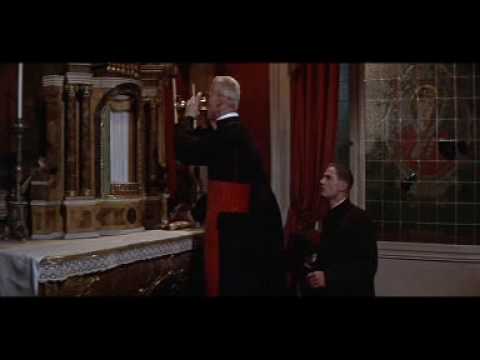

They purified the vessel, too! How apt.
Firstly, we should all stop and say a prayer for this priest. The disrespect he shows to the Blessed Sacrament and the neglect he demonstrates for his priestly duties may indicate deeper problems. Priests are, every day, under assault from Satan. God’s grace sustains and strengthens us, but temptations are real. Priests are weak human beings. Whether this priest struggles with doubts of faith, laziness, pride – or he was appallingly poorly trained – does not matter: pray for him.
Next, it sounds you have done what should be done. You asked the priest and found out that he, wrongly, believes the sacristan can purify the sacred vessels. You asked the bishop to institute your as an acolyte, so that you can licitly purify the vessels, and the bishop has not acquiesced. It seems to me that – given the extraordinary circumstances – you can in good conscience care for the sacred vessels and the Blessed Sacrament quietly, unobtrusively, and without fanfare. Don’t to go about telling everyone that “Father’s not doing his job so I have to step in and do it for him”. That would be bad for many reasons.
Meanwhile, were you to write a brief, respectful, factual, wholly objective letter to the bishop to explain the situation with a copy of the letter to the Congregation for Divine Worship and Discipline of the Sacraments, it is possible that there could be down the line some movement in this regard. Be sure of the facts before you write.
And don’t forget to pray for the priest.