So I’m reading my email. A reader sent the text of a Wall Street Journal piece (they have an evil paywall) entitled “Free Our Churches From the Ugly and Stupid“.
“This hath potential”, quoth I, and in did I delve.
Pure gold.
So I get to the end of the brilliant brief essay only to discover that it was penned by Anthony Esolen! Moreover, it was abridged from his recent book – which I instantly added to my Kindle Wish List … Out of the Ashes: Rebuilding American Culture
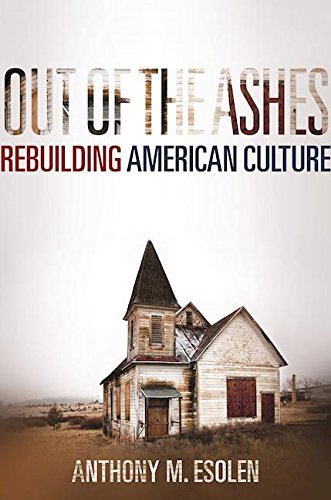
I’ll bet that this book will apply also in the UK, Canada, etc.
Here’s a sample from the WSJ version with my emphases and comments:
The great iconoclasm of the 1960s buried much of Christianity’s best art and music.
I have seen, in Catholic churches, minimalist Stations of the Cross that hardly can be recognized as depictions of the Passion. I have seen crosses that look as if a modernist Jesus were flying with wings outspread, like a theological pterodactyl. I have seen the Eucharist relegated to what looks like a broom closet. I have seen a baptismal font that bubbles. I have seen beautifully tiled floors, with intricate cruciform patterns, covered over with plush red carpet.
I have heard for decades effeminate “hymns” with the structure and melody of off-Broadway show tunes. I have read hymn texts altered so as to obliterate references to God with the personal pronoun “He.” This music would not be acceptable for a jingle to sell jelly doughnuts on television.
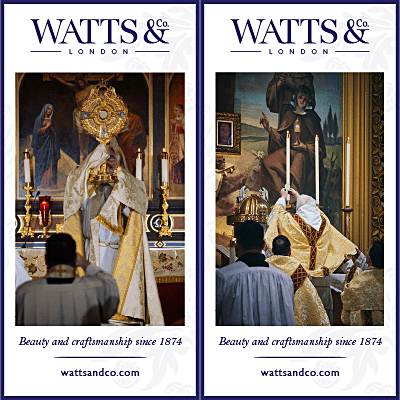
I have seen and heard enough. We must get rid of everything ugly and stupid from our churches, most of it visited upon them since the great iconoclasm of the 1960s. What’s needed is genuine art that stirs the imagination and pleases the eye, that entices the soul with beauty before a single word of a sermon is uttered. [Do I hear an “Amen!”?]
Let me use an analogy. I am involved in the restoration of an old home that for more than 100 years served as the rectory of a Catholic parish in Nova Scotia. One of the first things we did was to tear out carpeting that had gotten dingy and moldy. Beneath lay plywood and linoleum. And underneath that?
We found in most of the rooms oak and maple floors, with three-inch-wide strips laid in handsome patterns, squares enclosing diagonals, and a large diamond set in the center of the original parlor. The craftsmanship was impressive, the execution precise. Other floors had large planks of seasoned hemlock, which absorbs moisture from the air and grows tougher from it. The hemlock is as old as the home’s foundation.
This kind of plywood covers beauty everywhere in today’s churches. You are not only walking on it. You are looking at plywood on the walls, hearing plywood from the pulpit, and singing plywood instead of hymns.
The first thing we can do to return beauty to our churches is to swallow chronological snobbery and find out what our ancestors, even those who could not read or write, achieved. I am speaking about more than the fine craftsmanship of well-turned balusters and newels, though we should desire that too.
[…]
Today, the word of God is proclaimed in translations that have all the charm and wonder of a corporate memorandum. Must ordinary people be fed the drab and insipid? The politically correct—another thing thrust upon people by their ecclesiastical betters—is always ugly. Get rid of it, period, no excuses, no exceptions. What Christ hath spoken well, let man not paraphrase. Let grace in the word be one humble way in which we show our desire and our gratitude for the grace of God.
Fr. Z kudos.
Run, don’t walk, to get his book.
And let’s get back, now, to ad orientem worship!

Click!