A priest friend of mine in New York says that the New York Times (aka Hell’s Bible) sole reason for continuing is to make liberals feel good about themselves.
On the day Pope Benedict XVI visits the Roman Synagogue comes an NYT piece with the usual smarmy anti-Pius XII slant.
NB: The NYT has beneath its articles links to related articles from the past. The NYT on its editorial page has a feature of editorials from the paper’s archive. Today the past articles are about how insensitive the Church is about Jews, blah blah, and the archive editorial concerns that significant players in modern history Conan O’Brien.
The New York Times never cites its editorial from Christmas Day 1941:
"The voice of Pius XII is a lonely voice in the silence and darkness enveloping Europe this Christmas…He is about the only ruler left on the Continent of Europe who dares to raise his voice at all."
The Gestapo in 1942 understood what Pius was talking about. In a report they summed up: "in a manner never known before…the Pope has repudiated the National Socialist New European Order [Nazism]. It is true, the Pope does not refer to the National Socialists in Germany by name, but his speech is one long attack on everything we stand for. …Here he is clearly speaking on behalf of the Jews."
The Gestapo got it, but the present editors of the New York Times are a bit more obtuse.
That said, let’s have a look at what Hell’s Bible has to say with my emphases and comments:
Pope Quiz: [yuck yuck… get it?] Is Every Pontiff a Saint?
By DAVID GIBSON
Published: January 16, 2010When Pope Benedict XVI approved a decree last month that nudged nearer to sainthood his controversial wartime predecessor, Pius XII, he sparked another round of the sort of Jewish-Catholic disputations that have marked his papacy [That is not what has marked this papacy, btw, unless you are in the sphere of the NYT. What is marking this Pope’s papacy is a developing theology of the environment, and of course his work as the "Pope of Christian Unity". ] and even cast doubt on whether his trip to Rome’s main synagogue, set for Sunday, would go on. [It didn’t cast much doubt.]
The Vatican paired the announcement of Pius XII’s “heroic virtue” — the step before beatification, which would be followed by canonization, or sainthood — with a similar declaration about Pope John Paul II, who was considered a great friend to the Jews. No matter. Jewish leaders were furious, [I am forced to ask, once again, when do Jews consult the Church about, say, who should be declared a righteous gentile?] though Rome’s Jews decided to go ahead with the papal visit. [Of course they did.]
Pope Benedict’s decision of course renewed the longstanding debate over Pius’s World War II legacy (was he “silent” or even complicit in the Nazi extermination of the Jews?), [This is the sort of thing to which I alluded at the top. He tosses this smelly question out here and it will hang in the reader’s mind like a sock on a shower rod through the rest of the article. He could have asked the question, "Was Pius XII the quiet rescuer of thousands of Jews during the war?] but there is another question here that goes beyond Pius:
Should any pope be made a saint? [It is hard to fathom why you would ask this question unless you were, say, anti-Catholic.]
The church counts less than a third of all 264 dead popes as saints, and most were canonized by popular acclaim in the first centuries of Christianity, often because they were martyrs. Only five were canonized in the entire second millennium, and when Pius X, who died in 1914, was made a saint in 1954 — by Pius XII — he was the first pope so honored in nearly 400 years.
Now nearly every recent pope is on the canonization track. John Paul II beatified Pius IX, the 19th-century pope who is a polarizing figure because of his belief in the power of the papacy and his views on Judaism. [Remember… just as for the writer the papacy of Benedict XVI is about Jews, so too was the papacy of Pius IX.] But like Benedict, John Paul did a little ticket-balancing. He simultaneously beatified the popular John XXIII, who convened the liberalizing Second Vatican Council in 1962. The canonization process for Paul VI, who followed John XXIII, is underway, and there is a campaign to beatify John Paul I, who reigned a mere 33 days before his death in 1978.
[This is where the writer goes even more seriously off the rails.] This trend, by some accounts, is creating several problems. One is that it can dilute the meaning of sainthood; [Ummm… no, actually not. The cause of a well-known is actually an opportunity for people to learn more about what the Church teaches concerning holiness, and demonstrates that it is possible to live a good life.] all who die and go to heaven are saints, but those officially recognized as such by the church are exalted as worthy of veneration and imitation. [Ridiculous. The causes of saints don’t give the impress that all go to heaven. If there were anything we as Catholic do these days that give that impression it must be the insipid funeral practices we have veered into since the Council.] Is every pope such an exemplar? Moreover, by canonizing predecessors a reigning pope elevates the throne he himself occupies and practically ensures that his successor one day will declare him a saint as well — as if sanctity were an award for becoming pope. [Silly. But I think the writer, to color your view, is trying smear the whole process of a cause, suggesting that this is somehow shallow or corrupt, or blend of politics and vanity such as might have been displayed by Julio-Claudian emperors.]
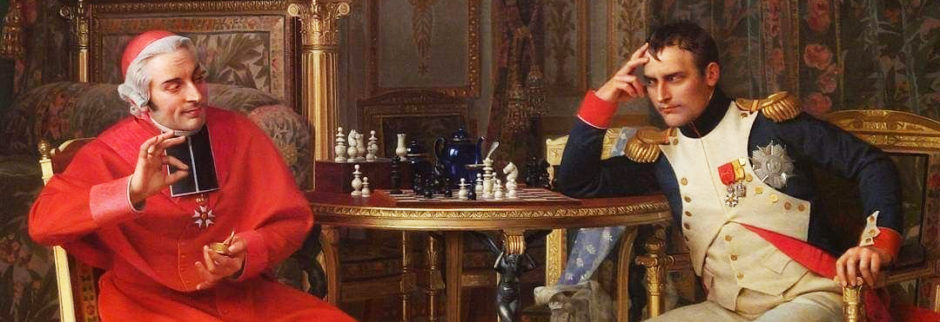
[The writer’s narrow view of the material is made even more funnel-like now. Notice which rickety hobby-horses he trots on now.] This overlooks the reality that the cardinals in a conclave are electing a leader to govern the church. [That’s not a non sequitur, is it.] As the German theologian Karl Rahner put it, if a pope turns out to be a wonderful Christian, that’s “a happy coincidence,” just as when the president of the chess club is also a great player. It is not necessarily relevant, however, to the health of the chess club — or the church. [Here we can agree with Karl Rahner.]
In fact, conclaves have often looked for a pope who could govern firmly and defend the church in a dangerous world because that’s what a pope usually had to do. But in modern times, as popes became, first, “prisoners of the Vatican” after the unification of Italy in 1870, and then globetrotting media stars a century later, they also became the universal face of Catholicism. [So?] “Before that, most Catholics would be hard pressed to name the pope and almost none would know what he looked like,” said Christopher Bellitto, a church historian at Kean University in Union, N.J. “After 1870, with cheap printing and his prisoner-of-the-Vatican status, the pope’s face became recognizable and a rallying point for those who wanted to see the world as standing against the church.” [Ummm…. the world was standing again the Church.]
[This next part should sound familiar to people who keep up with liberal cant against Roman centralization, etc.] This “papalization” of the church means that every pope must now be seen as a holy man, indeed the holiest man in the church, [silly] even if there are pressing issues of governance that would require more savvy than piety. Although John Paul II is a lock for sainthood, serious questions about his administration of the church are emerging as the clergy sexual abuse scandals reveal how he neglected the mundane but critical tasks of being pope. [Again, the chance to smear. The Church is a pretty big and far-flung organization. Who can actually govern it in the manner he suggests? Is it possible? And should a pope attempt to govern in the manner he suggests, he would be labeled as a despot by the same liberals who whine that he didn’t do enough.]
The Rev. Richard McBrien, [surprise!] a theology professor at Notre Dame and author of “Lives of the Popes,” [Is that the book in which he has his "borrowed" material?] suggested that canonizations may be a defense against criticism of popes, and he said the church would do better to canonize more saintly lay people — parents and grandparents and regular holy folk “with whom the overwhelming majority of Catholics can identify.” [Has that been done?]
“The only one of the recent batch of papal candidates for canonization who is at all credible is John XXIII,” [ROFL! That’s it?] Father McBrien wrote in an e-mail message. “But I would gladly trade John XXIII’s candidacy for the suspension of procedures on behalf of the other recent popes.” [Retire.]
Yet to avoid canonizing John Paul II or any pope at this point could come off as an insult, or a knock on the papacy. That forces promoters of papal canonizations, and defenders of Pius XII in particular, to create a false division between official actions and personal piety. [? So, it a Pope makes a mistake in judgement, that means that he was not holy? I guess that wouldn’t help the cause of John XXIII. Say what you want about the Council, but if we look at what has happened in the last few decades no one can say that the choice to have a Council … and a Council without a clear agenda at he opening, btw,… didn’t cause upheaval and confusion redounded into our own day. It was at least controversial and questionable. If that is the case, then his holiness must also be at question.] As a papal spokesman said in defending Benedict’s decision on Pius, “the evaluation essentially concerns the witness of Christian life that the person showed … and not the historical impact of all his operative decisions.” [The development of the Gregorian Calendar was of great benefit for the world, but that benefit did not necessarily mean that Gregory XIII was thereby holy.]
But as Mr. Bellitto said, “based on this formula, plenty of nice people who did awful things would qualify for sainthood — and they’d hardly be models for the rest of us.”
Such a restricted view of sainthood also easily dismisses the realities of a pope’s job — and the debatable record of Pius XII. Hans Küng, [surprise!] the dissident Swiss theologian, recalls an episode during his days as a student in Rome in the 1950s when the private secretary of Pius XII, Father Robert Lieber, visited the seminary. Father Küng and the other young men pestered Father Lieber about whether the aristocratic Pius was a saint: “No, no!” the priest insisted. “Pius XII is not a saint. He is a great man of the church.”
It’s a verdict that makes Pius XII neither villain nor plaster icon, but neither does it answer the question of what a modern pope should be — a leader of the church or a model of sanctity? [What an absurd question. Of course a Pope ought to be a model of sanctity. So should your spouse, teacher, neighbor, football coach and boss.]
David Gibson, author of a biography of Benedict XVI, writes on religion at PoliticsDaily.com.
A version of this article appeared in print on January 17, 2010, on page WK4 of the New York edition.
Dreck.
From the New York Times Christmas Day editorial of 1942:
Pope Pius expresses as passionately as any leader on our side the war aims of the struggle for freedom when he says that those who aim at building a new world must fight for free choice of government and religious order. They must refuse that the state should make of individuals a herd of whom the state disposes as if they were a lifeless thing.