A couple weeks ago in my column for The Wanderer I spoke of the work of Christine Mohrmann. Also, I have on various occasions opined that sometimes it is okay for something you know to be a translation to actually sound like a translation.
This is from, Whosoever Desires, a group blog by young Jesuits. They seem to be getting the right ideas!
In Praise of Clunky Translations
On November 17 the USCCB approved the final segments of a new English version of the Roman Missal. A few have already criticized the Vox Clara translation as “slavishly literal” (here) [Imagine! A "Slavishly literal" translation! O the humanity!] and disrespectful of the “natural rhythm and cadences of the English language” (here). On purely grammatical and stylistic grounds, I am actually inclined to agree with these criticisms. However, a recent rereading of Liturgical Latin, Christine Mohrmann’s slim classic from 1957, has reminded me that slavish literalism and barbarous constructions have always been a hallmark of Christian liturgical language.
Mohrmann—at pains to show that early Christian Latin was hardly the Latin of the “common man”—notes that biblical Latin was marked by precisely those stylistic features most criticized in the new Roman Missal:
The earliest Christian Latin, like the Greek, bears a strong Biblical imprint. The translating procedure, however, of the earliest translators, does not markedly differ from that employed by the translators of the Septuagint. We find the same word-for-word method of translation which differed so radically from that recommended by Cicero. The Latin translators of the Bible show the same reverence for the original text which had also been a guiding principle of the Septuagint translators.
Barbarisms, neologisms, and foreign idioms abounded in the first Latin translations of the Bible. This translation philosophy naturally spilled over into Latin liturgical texts. Besides Hebrew barbarisms such as “Amen” and “Alleluia,” Mohrmann singles out words that were plucked from their profane use and almost entirely retooled for Christian prayer, words such as confiteor, gloria, credo, and humlitas.
Mohrmann also observes that, even when Jerome re-translated the Bible, he was more concerned to account for the shifting sensus of Latin words than to update archaisms or recherché diction. Jerome naturally saw that, in view of the effects of time on language,
some changes were obviously necessary to conserve the purity of meaning. When the old words rendered the meaning accurately, these words were preserved. For instance, when there was a general movement to replace the old words magnificare, honorificare, and clarificare by the “European” term glorificare, Jerome will have nothing to do with it, because in his opinion the use of the words threatened with extinction does not endanger the original meaning… [consubtantial] We may say that Jerome, like Ambrose and Augustine, had a sincere appreciation of the biblical style, and he tries to leave it intact and maintain it as far as possible.
If Jerome were apply this translation philosophy to the English Missal, he might leave a rare or archaic word like “gibbet.” [Of maybe even…. gulp… "ineffable"?] On the other hand, he would probably update Holy “Ghost” to Holy “Spirit,” since recent shifts in the English language freighted “ghost” with a cargo of eeriness and malevolence.
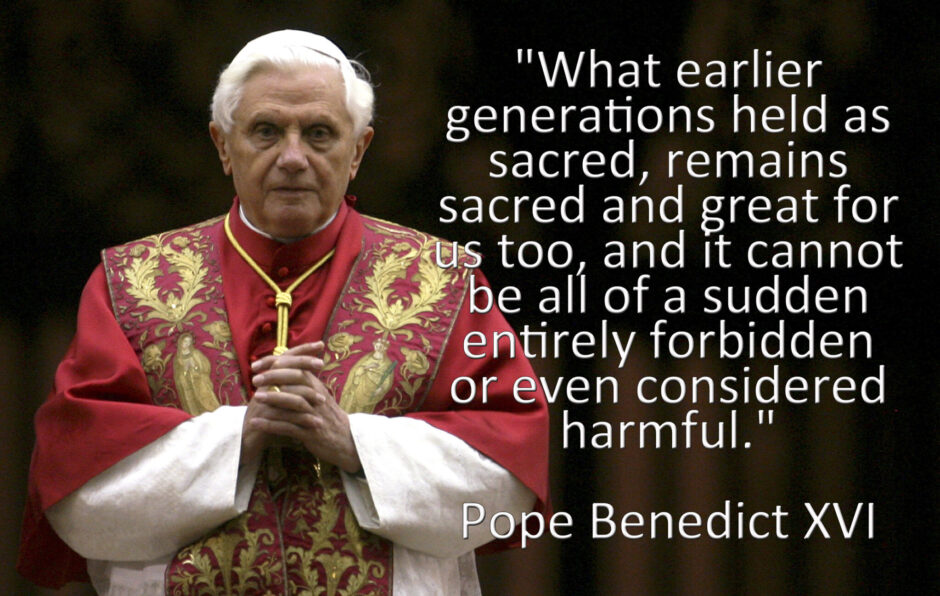
On Mohrmann’s view, the net effect of this conservative tendency was actually creative. Christians slowly forged a sacred language, one perhaps less apt for instantaneous communication, but one more apt for corporate expression. This second function of language was no less important:
Whereas … language used primarily as a means of communication normally strives toward a degree of efficiency … language as expression usually shows a tendency to become richer and more subtle. It aims at becoming, by every possible means, more expressive and more picturesque, and it may try to attain this heightened power of expression both by the coining of new words and by the preservation of antiquated elements already abandoned by the language as communication.
In this connection, English speakers might call to mind the solemn “thy’s” of the Our Father and the stern “thou-shalt-not’s” of the Decalogue. [Gosh! We did a poll about that here, didn’t we?] They might also contrast the expressiveness of a cup that “runneth over” to that of a cup that merely “overflows.”
In fact, compared to the slavish deference that the first Latin “missal” showed to the Hebrew Scriptures, the respect that the Vox Clara translation pays to its Latin forebear is actually very slight. For this reason, the aura of the sacred will be faint. The new translation does, however, begin to give due consideration to the expressive power of language. To this extent, it joins the age-old mainstream of Christian liturgical piety.
Once again, our cup runneth over.
"Runneth" twice in one article?
Tooo haaard!
Good work men. WDTPRS kudos.