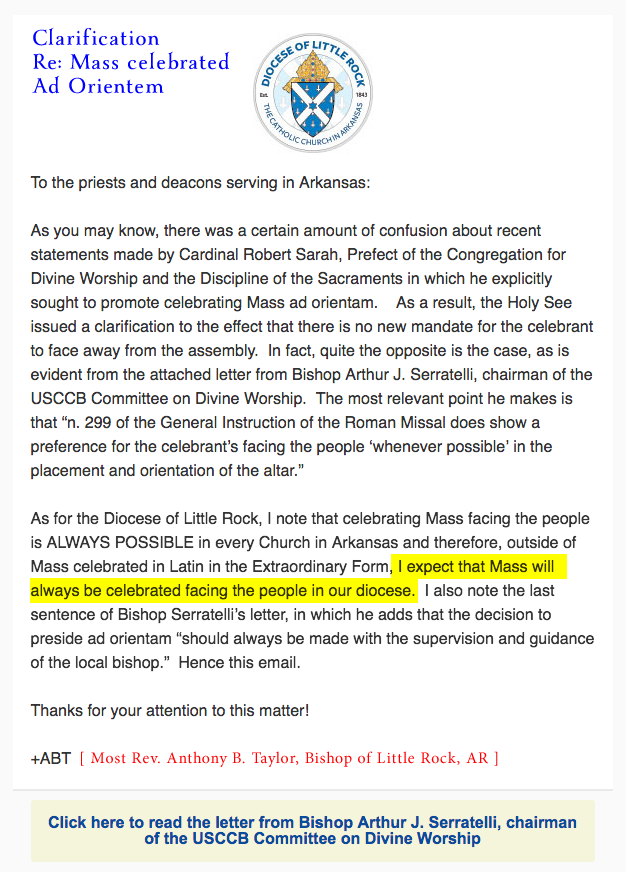
If email were rain, I’d be soaked. I was sent an image of a letter sent by Bp. Anthony Taylor of Little Rock, Arkansas, to priests. In this letter, the Bishop says that he “expects” that Mass always be celebrated “facing the people”.
CCWatershed has a good summary of this sad new development and an image of the letter with the relevant text highlighted.
Here’s the problem.
Bp. Taylor cites a letter of 12 July 2016 from the head the USCCB’s liturgy committee, Bp. Serratelli, in the wake of Card. Sarah’s personal plea to priests to say Mass ad orientem. Once again, however, Serratelli cited the English MISTRANSLATION of GIRM 299, incorrectly asserting that 299 says that it is preferable that Mass be celebrated “facing the people”. That is NOT what 299 says.
Based on this error, Bp. Taylor then states that he “expects” that the Ordinary Form will be “facing the people”.
He “expects” that. He can’t mandate or command that. Why?
On 10 April 2000, the Congregation for Divine Worship issued an official response about this matter:
This dicastery wishes to state that Holy Mass may be celebrated versus populum or versus apsidem. Both positions are in accord with liturgical law; both are to be considered correct.
There is no preference expressed in the liturgical legislation for either position. As both positions enjoy the favor of law, the legislation may not be invoked to say that one position or the other accords more closely with the mind of the Church.
In a nutshell, bishops can’t overrule universal laws, including rubrics.
That last part is an overstatement, by the way: the rubrics of the Mass in Latin in the Missale Romanum clearly indicate that at times the priest turns away from the altar to face the people and then turns back to the altar. Nevertheless, the Congregation is clear. And Bp. Serratelli’s letter goes on to acknowledge this fact (not quoted here).
I would only add that it seems that in 2012 Bp. Taylor repressed a TLM community by placing myriad conditions for the celebration of the older form of Mass. In 2011 the document Universae Ecclesiae from the Pontifical Commission “Ecclesia Dei”, would clarify. Too late. More on that HERE. To be fair, right now in N. Little Rock, the FSSP have a toe hold at a parish, St. Patrick’s. It is not their own church, but they have some use of it for early daily Mass. Also, confessions are heard for 30 minutes before each Mass. What a great service to that parish from these good FSSP priests.
Back at CCWatershed, there is a note at the end which I cordially and sincerely endorse, to wit (my emphases):
Some have already ascribed bad intentions to Bishop Taylor, but I disagree. I suspect he sent his letter without knowing the CDW had specifically said the diocesan bishop cannot outlaw “ad orientem.” I believe that once Bishop Taylor becomes aware of that statement, he will issue a retraction. Furthermore, I strongly suspect Bishop Serratelli will retract his letter when the correct translation of paragraph 299 is brought to his attention.
To help everyone involved, let’s review 299. Again.
Altare exstruatur a pariete seiunctum, ut facile circumiri et in eo celebratio versus populum peragi possit, quod expedit ubicumque possibile sit.
… And now for the correct translation…
The altar should be built separated from the wall, which [namely, the separation of the altar from the wall] is useful wherever it is possible, so that it can be walked around and (so that) celebration towards the people can be carried out at it.
For those who make the rookie mistake of plodding along in Latin word for word, as if that’s how Latin works, let’s rearrange 299 to make it easier:
Altare exstruatur a pariete seiunctum, quod expedit ubicumque possibile sit, ut facile circumiri et in eo celebratio versus populum peragi possit.
Let’s make it more visual yet. To what does that quod refer?

The relative pronoun quod refers back to the whole first part. The ut clause in the middle (which creates a messy, but still readable sentence if you don’t fall into the rookie trap of reading Latin word for word in order) adds some additional information about how far away from the wall the altar should be built. It is a vast stretch to imagine that that quod refers to the infinitives in the ut clause (circumiri… peragi). It is also a vast stretch to force quod to be a conjunction (therefore without gender or number). No, the quod, in its role as a relative pronoun, refers most naturally and logically to the main clause.
BTW, Fr. Reginald Foster, the long-time Latinist to Popes, agrees with me.
Fr. John Hunwicke, now of the Ordinariate of Our Lady of Walsingham in England, taught Classical Languages for decades. HE wrote in a Guest Editorial in 2001 in Sacred Music:
Paragraph 299 says:
The High Altar [not, be it observed, every altar] should be constructed away from the wall, so that the option is open [possit] of walking easily around it and using it for Mass facing the people. This [i.e., having the altar free-standing so that the options are open] is desirable wherever possible.
GIRM continues – see paragraph 277 – to accept that there will be churches where keeping the options open in this way is not “possible.” And notice that according to the Oxford Latin Dictionary, ubicumque means only wherever. [not “everywhere”]
You rightly point out that the new GIRM repeats the instruction that, at certain points, the priest (or deacon) must be “turned to the people” (versus ad populum), clearly implying that he may lawfully be turned away from them at other times. You could have mentioned that these are not merely careless repetitions from earlier versions of the GIRM; I have noticed three places (Paragraphs 154, 181, 195) where the phrase is now added to
the text of the Editio typica prima, and these paragraphs occur in the description of a normal Sunday community Mass, celebrated perhaps with a deacon.
Incidentally, [NB] I suspect that a redaction critic, asked why the quod … clause has been added, might surmise that the addition was intended to emphasize the need for flexibility in the placing of the altar (it’s a good idea [expedit] to have a free-standing altar where this doesn’t cause too much trouble), rather than to discourage ad orientem.
Which is surely why this paragraph is mistranslated so often!
Elsewhere, Fr. Richard Cipolla, whom is no Latin slouch himself – an understatement – wrote:
That famous “quod” that introduces the relative clause cannot possibly refer to the celebration of Mass versus populum. The English translation has been faulty from the beginning, or rather, from when that clause was added. In addition the Congregation for Divine Worship in September 2000 rejected the interpretation that 299 made a free -standing altar obligatory and therefore versum populum obligatory.
It is clear from the Latin of the GIRM and the rubrics in the Ordo Missae that ad orientem worship is NOT to be, indeed cannot be, excluded. It’s RIGHT THERE in the book.
It is clear that, according to the Latin of the GIRM and the rubrics in the Ordo Missae that versus populum is also NOT to be, indeed cannot be, excluded. Again, check the book.
Bishops cannot forbid ad orientem worship. They can torture priests who say Mass ad orientem in a thousand ways. But that would be abuse of power.
The linguistic situation is pretty clear. The history of ad orientem worship is not to be denied. The legal/juridical/rubrical dimension is not really that complicated (if you are honest about it and have the correct information).
That said, what we have to do now is go deeper into the theology of the two manners of “orienting” Mass.
If we say that, theologically Holy Mass is to be “towards the Lord”, which of those positions (ad orientem versus or versus ad populum) will more fully manifest and also more fully facilitate an experience of Mass as being truly offered “towards the Lord“?
Friends, Card. Sarah’s personal invitation, the Sarah Appeal™, to priests was a turning point. His ad orientem appeal is a catalyst to set in motion significant change. Each priest who takes up Card. Sarah’s catalytic call will in turn become a catalyst wherever he serves. The way a priest says Mass produces knock-on effects in congregations. Hence, those who support the Cardinal Sarah’s proposal are going to be persecuted. Pray for your priests and bishops. Pray that their minds and hearts be opened and that their actions reflect a loving balance of prudence and courage.
And, please, tell the TRUTH about 299.
Qui habet aures audiendi audiat!