 My friend Fr. Ray Blake, PP in Brighton, made excellent comments about “manliness” on his blog. HERE
I have been at a major church three times recently for some pretty important occasions, and each time only women read, and every time the female ‘music minister’ sat enthroned above [Ain’t it da truth? Sickening.] con-celebrating clergy as some sort of demi-bishop signalling to the people to turn their attention from the altar to her and join in the music, even when the celebrant sang things that would of themselves demand people participation, like “The Lord be with you”. No, I didn’t check, there might have been very good reasons for the exclusion of men from lay-ministerial positions but the fact it happened on three successive occasions just seemed to be making a point. Just so no-one can question my feminist credentials I only tend to use the Roman Canon and I always include those women at the end of the last list, chauvinists often just use EPII/III/IV, which only mention Our Lady. I don’t know if this is what people mean when they speak of feminisation of the Church, actually I think it might go deeper.
Looking around my own parish I see a lot of men who want to be manly but don’t actually know how to carry it off, the problem is mainly one of society, and the Church reflects society. However the Church does have the answers, as I said to one young man, after he had attended a friends raucous ‘Gay Pride’ party a few years ago and fled, ‘If you want to know want to know what manly love is like look at the crucifix’. Jesus is always the answer, though we might not be yet be able to form the question.
[…]
Certainly there seems to be a need to form men in the Gospel, and men today need Christ’s healing, and men feel alienated from the Church. At the back of my mind is an old adage: evangelise a mother, and she will bring with her her young children, evangelise a father and he will bring his wife and his sons and daughters and they will remain faithful.
[…]
There is a lot of risible B as in B, S as in S out there about a supposed “war on women”. Feminists fling that manipulative rubbish out there constantly. The real task we face is to fight the war on men and boys that is going on, in conjunction with the rise of unnatural (propagandized and manufactured) sexual “identity”.
Even if we stipulate that there is a war on women (in sense that girls and women are barraged with images that degrade them constantly and force them to conform, to become slutty or angry or coarser than faux-male), we have a war to fight on two fronts.
Men and women need to help each other be who they are meant to be! This is especially important, I think, in the role that women have in civilizing men and helping them, inspiring them, even provoking them to be who they are hard wired to be. If and when that breaks down, as it has nearly done now, the results will be even more horrific than we are seeing now.
The demonic division and confusion of the sexes will lead countless souls to Hell.
We must reclaim the image of God.
Our action as Catholics has to be both ad intra and ad extra. For the ad extra dimension, what we do in our homes (the domestic church) and in the public square, we must – among other things – resist every attempt to blur improperly or unnaturally God-created gender roles (e.g., same-sex “marriage”). We must defend the family. For the ad intra, we must also defend marriage and family – how weird is it to have to write that – even from the church’s shepherds along with certain (especially German – it’s almost always German) theologians.
Furthermore, let me put this bluntly, we should promptly and firmly invite and guide girls and women out of our sanctuaries.
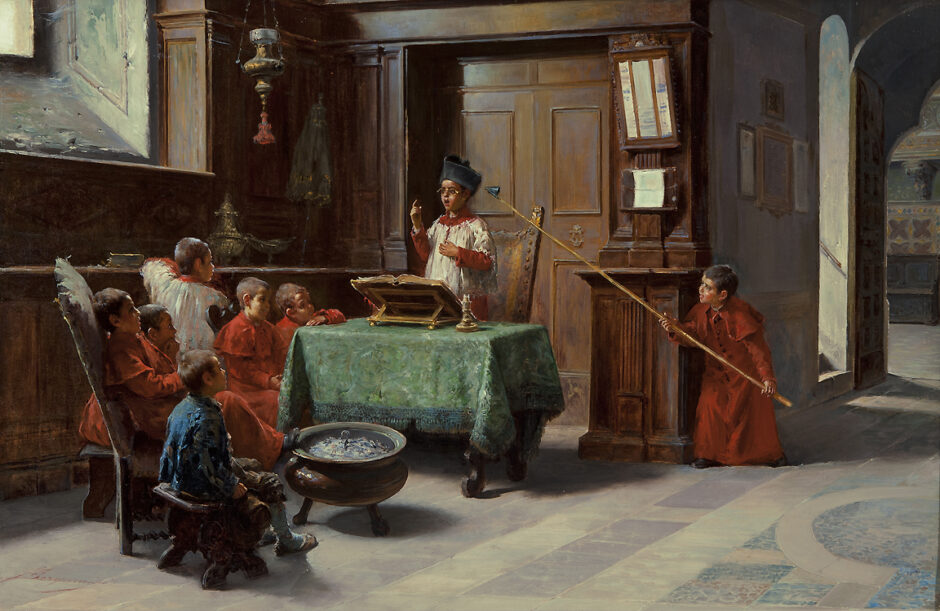
We need a return to male-only service at the altar together with ad orientem worship which underscores the transcendent aspect of our divine liturgy.
Our worship has been deeply and diabolically compromised in way that should keep all of us awake at night, apologizing to the Lord with a shiver of dread.
We are our rites. No undertaking of renewal within the Church – at any level, including the parish – can succeed unless and until we revitalize our liturgical worship of God. That is where we must begin. That is what we must constantly foster and defend.