From a reader…
QUAERITUR:
Recently there was a huge funeral in our cathedral for a 32nd degree member of the Freemasons. The local TLM community is very upset and crying foul. It’s a mess. Could you offer some insight? I have friends in the TLM community, but I only occasionally go mass with them.
Go to the TLM more often and be a cheerful good example of holiness and devotion!
Under the 1917 Code of Canon Law (can. 2335), it was clear that Catholics who joined Masonic organizations were excommunicated.
When the Code was revised in 1983, this explicit condemnation was broadened to say,
“A person who joins an association which plots against the Church is to be punished with a just penalty. However, a person who promotes or directs an association of this kind is to be punished with an interdict” (can. 1374).
The automatic excommunication is gone, but membership in such organizations is still forbidden.
The day before the 1983 Code was promulgated, the CDF reiterated the Church’s prohibition on membership in Masonic organizations, saying that such people are involved in seriously sinful matter and should not approach Holy Communion. It stated firmly that local bishops and bishops’ conferences do not have the ability to prescind from this declaration.
Masonry is serious stuff, folks. In North America, Masons may be seen as those good-hearted, civic minded men who drive around in little cars at the Fourth of July Parade, who host a circus for the kids, and who spend a lot of time and money helping out at the children’s hospital. Lately in these USA we have seen the money appeal commercials for Shriners Hospitals with the heart wrenching images of children.
Insofar as many of the members might be unwitting dupes whose primary interest is fraternity and civic pride, they seem innocuous. However, the philosophy that Masonry espouses is – at its core – opposed to the Church in every way.
In other parts of the world, where Masonry has stronger political connections, it fights the Church over the very heart and soul of the nation. The higher one gets in Masonry, the less able one is to excuse oneself as being an unwitting dupe.
Catholics should stay far away from involvement with Masons.
It’s unclear from the question whether the 32nd degree Mason was a Catholic or not. Since the excommunication is no longer automatic, but requires the intervention of the bishop, it is possible (but tragic, considering the consequences) that a Catholic could join the Masons, and even rise to such a high level, without the Church, out of mercy, applying a penalty to warn the individual of the peril he is putting his soul in.
The law requires that funerals be denied to three categories of people (can. 1184):
1) notorious apostates, heretics, and schismatics;
2) those who for anti-Christian motives chose to have their bodies cremated;
3) other manifest sinners to whom a Church funeral could not be granted without public scandal to the faithful.
The local ordinary (bishop or vicar general) is to have the final say if there is any doubt.
If the deceased Mason (and please, pray for his soul, even though it may be too late) was not Catholic, a funeral still may have been permitted to him in virtue of can. 1183: baptized persons belonging to a non-Catholic Church (e.g., Orthodox) or ecclesial community (e.g., Lutherans, Anglicans) may, in accordance with the prudent judgment of the local ordinary, be allowed church funerals unless it is established that they did not wish this. This canon is normally used when a non-Catholic spouse of a Catholic, who has dutifully attended Mass with his family for years, though never fully converted, has died and the family wishes the funeral to be in the Catholic Church. Or else, it could be applied when someone who belongs to a more obscure Orthodox or Oriental Church, living in a place with no real access to his own Church, turns to the Catholic Church for some spiritual support, but has not formally converted.
The law is relatively broad, and its interpretation is left to the local ordinary.
If an ecclesiastical funeral has been permitted to someone who had no right to it, or if the community is in disagreement with the local ordinary about the application of the law, an appeal could be made to the Holy See. It would be difficult to understand what could be gained from this. One cannot unring the bell. Perhaps it might forestall similar events taking place in the future.
What to do?
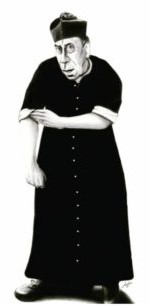
One option would be to gather in small groups after Mass over coffee and doughnuts to gripe and complain about how wacky and liberal things have gotten. Mutter a few invectives (I’d suggest raising a fist while muttering through clenched teeth, “Why I oughta…”), and, thereafter, bask in the self-satisfaction that the truth has been defended.
Another option is to get on your knees and pray. Pray for the poor deceased man. Let’s hope he was deluded and confused and did not enter into the Masons with full consent of the will based on adequate knowledge. Pray for his family. Pray for the local ordinary who may or may not have understood the full gravity of the situation when he made the call to permit the funeral, or who may not have been consulted at all! Pray for the priest who celebrated the funeral. Pray that the Church triumphs and defeats Masonry worldwide. Pray that our Church emerge from times of confusion and disarray that it may once again shine as a beacon for all those poor souls who have been deluded by dangerous philosophies.