From the Springfield Journal Record with my emphases and comments.
Mass trend: Latin making a comeback locally
By STEVEN SPEARIE
Correspondent
Posted Apr 26, 2009 @ 12:00 AM
SPRINGFIELD —
Early on a Saturday morning under the watchful gaze of archangels and the Gospel writers in a darkened church, a voice intones Hail Marys and Our Fathers with measured responses from a smattering across the church.
Worshipers cross themselves with holy water and gather missals while some women pluck mantillas — lace head scarves — from a box sitting on a radiator. Altar servers, dressed in black cassocks and white surplices, ready the altar, pausing to genuflect ramrod-straight each time they pass in front of the tabernacle. [All these elements would be a marked contrast to most parish across the US…. not all, but most. I especially like the observation about the care of the altar boys.]
At precisely 7 a.m., the lights burst on at Blessed Sacrament, the bells chime and the Rev. Arnaud Devillers, flanked by the servers, comes out and heads immediately to the back altar near the tabernacle. [There must be also a table altar.] Kneeling, with his back toward the congregation, [No… he is facing the same direction with the people.] he begins: “In nomine Patris, et Filii et Spiritus Sancti. Amen.”
When Pope Benedict XVI issued an apostolic decree in July 2007 calling for wider implementation of the Traditional Latin Mass — also known as the Tridentine Mass or the Extraordinary Rite — he noted that it isn’t “a museum piece, but a living expression of Catholic worship.”
Largely hidden from Roman Catholics since the late 1960s as a result of Vatican II — a period of sweeping reforms in the Catholic church — the Latin Mass has slowly crept back onto the scene.
Not your everyday Mass [Well… it was and it is.]
Blessed Sacrament Catholic Church in Springfield has been the setting for weekly Latin Mass since Jan. 31; the Church of St. Rose of Lima Chapel in Quincy, where Devillers is chaplain, has offered Latin Masses since November.
Latin Masses in Springfield and Quincy have attracted moderately sized but fervent followings, ranging from those who preferred the pre-Vatican II rituals to those simply curious about the Mass. A 7 a.m. Saturday Mass recently drew about 50 people, [Not bad for that day and time.] where attendance has leveled off.
Like Eastern Catholic and Eastern Orthodox rites, the priest mostly has his back to the congregation [Noooo…] during the Latin Mass. Masses are punctuated with long silences and — unlike the Masses in English familiar to most area Catholics — an absence of congregational participation. [WRONG! They are participating actively, alright. But their participation is more along of the lines of interior active receptivity, than mere outward expression.] Springfield’s Latin Mass has no music, while a full choir performs at Quincy’s weekly Mass.
Rosanne Wiatroliak, 48, of Springfield says she went to the Latin Mass at Blessed Sacrament “to see what I remembered (from my childhood.)
“I don’t remember being as separated from the Eucharistic celebration (as I did before),” [she isn’t] she says. “I felt like a spectator this time around. [Many do feel that way, at first. Then they learn what is really going on.] It was harder to follow. I’ve gotten closer to understanding (the Latin) and following along. You really have to stay on your toes unless you’re fluent in it.” [Yes… people should focus and pay attention… at Mass!]
“It’s a lot more contemplative,” says Jim Dodge, like Wiatroliak a Blessed Sacrament parishioner who lives in Springfield. The 41-year-old took some Latin in high school, but says he leans on a Latin-English missal to follow along.
An eye on the past
Under Pope Benedict’s personal decree, Summorum Pontificum, groups requesting the Latin Mass may approach a pastor who knows how to say one directly, bypassing the bishop. [Well… that is a negative way to put it. It is better to see this as not burdening the bishop with extra duties.]
While the rite has the enthusiastic support of Springfield Bishop George Lucas, it has created some controversy nationally, with some experts citing Pope Benedict’s aversion to modernism. [I think the Catholic Church has an aversion to modernism (at least on paper!). But I think the writer doesn’t intend Modernism. I think he is implying that Pope Benedict has an aversion to anything "modern". Which isn’t the case.] There is speculation that it may pave the way for other conservative advances. [Notice how "conservative" and "modernism" are juxtaposed.]
Devillers is a member of the Priestly Fraternity of St. Peter, a society founded with the endorsement of then-Pope John Paul II with the purpose of celebrating Mass “according to the traditional Roman Rite.”
Before that, Devillers was allied with excommunicated French archbishop Marcel Lefebvre in the Society of St. Pius X. Lefebvre founded the society that opposes some of the modernizing reforms of Vatican II. But Devillers left that society in 1989, citing Lefebvre’s increasingly extremist views.
Lefebrve, who ordained Devillers, broke with the Vatican in 1988 when he illicitly consecrated four bishops, including Bishop Richard Williamson. Williamson has said the numbers of Jewish casualties in World War II were inflated. (Earlier this year, the Vatican lifted the ex-communications on all four bishops, though they are not in full communion with Rome.)
There is also the matter of practicality.
Few Springfield priests feel comfortable with the rite’s arcane rituals, or rubrics, with few having been trained in them. [A couple things. The writer uses "arcane" here. In a sense that rite is good, in that the rites of Mass are about mystery. However, they are not arcane if he means they are very hard to learn. Any puzzle is easy once you know the answer. It is simply a matter of learning. Through the centuries very many priests who weren’t very bright managed to say Mass with the older form. If they could do it, priests can do it today. ]
The demand of other pastoral services, including Spanish-speaking Masses, may prevent already overworked priests from widely implementing the Latin Mass. [Not to mention the lack of will.]
Bishop Lucas has periodically granted permission for Latin Masses. But they have been celebrated infrequently over the past decade in the Springfield diocese, which stretches from the Mississippi River towns of Quincy and Alton east to the Indiana border.
Devillers says Pope Benedict’s motivation in part was to reach out to conservative elements, [That is certainly one motive. But the far more important motive doesn’t have anything to do with them.] such as the late Archbishop Lefebvre’s group, which still does not have normalized relations with Rome.
The misperception is that there is only “one rite,” or Mass in the local language, when there are in fact 22 “main rites,” Devillers says. More importantly, he adds, Vatican II never abolished the Latin Rite.
“What Pope Benedict is saying is if people are still interested in the Extraordinary Form, why not keep it?” Devillers says.
Liturgy expert Dennis Martin of Loyola University Chicago says the familiar Ordinary Rite, or Novus Ordo, was crafted by a liturgical commission [Liturgy cobbled together by committee.] after Vatican II. The idea, Martin says, was “a limited call for (liturgical) reform,” and Vatican II made no mention about totally eliminating the Latin Mass and replacing it with the locally spoken language. [Exactly.]
A rare skill
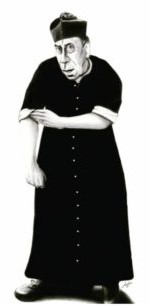
Wearing his preferred long black cassock, Devillers says he has a two-pronged mission during his one-year trial run at Quincy: build the community at St. Rose of Lima Chapel and serve as a resource for priests from around the diocese who also might be interested in learning the Extraordinary Rite.
Devillers says a handful of priests — mostly younger ones [No surprise.] — have approached him for instruction.
“The main difficulty is not the rubrics, it’s the Latin,” says Devillers, the former superior general of the Priestly Fraternity of St. Peter.
But adding Latin Masses — against the backdrop of overextended priests and other initiatives — is “always a concern,” Lucas admits, adding that it has to be judged “in terms of personnel and time.”
Even the Rev. David Hoefler, parochial administrator at Blessed Sacrament, says time hasn’t allowed him to follow through on Latin Mass instructions. [A couple of generations of priests have been cheated.]
Blessed Sacrament did not add any Masses to accommodate the Latin Mass. The parish was already offering the Saturday morning service in English, so Devillers says Mass at a time when Catholics already were gathering to worship. Hoefler says for now the parish can’t add any more Masses, in Latin or English.
Diocesan personnel and others deny that the Latin Mass is dividing congregations or that groups are using their muscle to advance further causes. [And what would those causes be?]
“I hope that’s not the case (here),” says Rosanne Wiatroliak. “I don’t know and I can’t judge. It would be sad if someone used it that way.”
Devillers further denies that a sort of “ghetto Catholicism” is being built at St. Rose of Lima, [The second time we see "denies".] which offers a wider range of Latin Masses and pre-Vatican II church. He points out that many people who come to the refurbished chapel — it is a former diocesan church but doesn’t have standing as a parish — belong to other parishes around Quincy, a largely Catholic town 115 miles west of Springfield.
“It’s the same faith, the same sacraments and the same sacrifice of the Mass,” Devillers says.
Jim Dodge says he doesn’t see any problem with the two forms of the Masses co-existing.
“To me, it’s the genius of the Catholic Church,” Dodge says. “It’s a ‘both and.’ It’s like the church’s view of celibacy and marriage. Both are positive goods.”
Steven Spearie can be reached at spearie@hotmail.com or 622-1788.
Not a bad article. The writer took the time to speak with and quote people who were informed.
Good news.
Brick by brick.