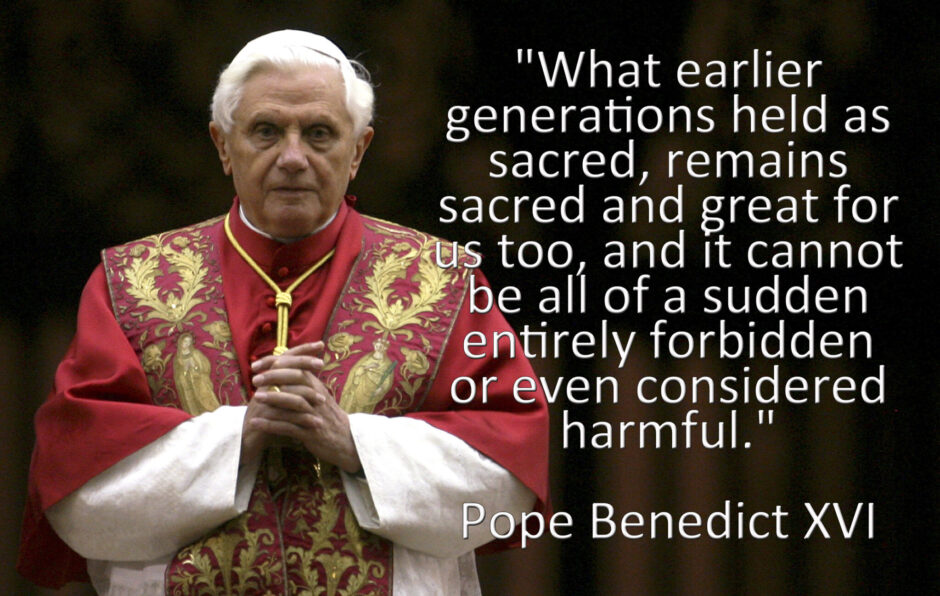
The scapegoating of Card. Castrillon continues
Card. Castrillon is taking the heat for the brouhaha over the SSPX/B16/Holocaust syndrome.
Watch how forces within the curia will line up to take turns pushing him under the 64 bus.
Our friends at Rorate have a blurb from a French interview in La Croix with Fr. Lombardi, spokesman for the Holy See:
Could it [the commotion caused by the Decree lifting the excommunication] have been avoided?
Honestly, the delicate point is to know who knew the opinions of this man. When it is proposed to the Pope to lift the excommunication of four Bishops, it is not an important number, as [it would be] if they were 150. They are known, these four Bishops. Undoubtedly, the people who managed this situation were not aware of the gravity of the opinions of Mgr Williamson. It is true that the negotiations were conducted with Mgr Fellay. But the positions of the other Bishops were not taken into consideration. What is certain is that the Pope ignored it. If there was someone who should know it, it is Cardinal Castrillon Hoyos.
If the positions of the other three SSPXers weren’t taken into consideration, how could those positions have then been ignored? But let that pass.
I can hear it rising up now…
This is assuming a Watergatesque patina.
The press rises up. The question is drawled…
"How much did the Holy Father know and when did he know it?"
In any event… here is the link to the piece in La Croix.
Meanwhile, at Reuters… we have this.
Spokesman says Vatican can’t control its message
Thu Feb 5, 2009 12:45pm EST
PARIS (Reuters) – The Vatican does not have control over its own communications and should improve the way it presents controversial statements, [Dýa think?] spokesman Rev. Federico Lombardi told a French Catholic newspaper on Thursday.
Lombardi spoke to the daily La Croix after almost two weeks of heated debate over Pope Benedict’s decision to lift the excommunications of four ultra-traditionalist bishops, one of whom has denied the Holocaust.
Jewish groups, Catholic bishops and German Chancellor Angela Merkel criticized Williamson’s comments and many urged the Vatican to ensure the four bishops respect reforms of the Second Vatican Council (1962-1965).
"We didn’t control the communications," said Lombardi, whose office originally announced the pope’s decision in a simple statement accompanied by the Vatican legal document that readmitted the four back into the Roman Catholic Church.
"I think we still have to create a communications culture inside the Curia, where each dicastery (ministry) communicates by itself, not necessarily thinking of going through the press room or issuing an explanatory note when the issue is complex." [Oh my! Does this sound familiar? I even wrote yesterday about the culture of fear in the Curia about social communications!]
The Holocaust denial by Bishop Richard Williamson, broadcast three days before the Vatican announcement, overshadowed the public discussion of the move. Under heavy criticism, the Vatican demand on Wednesday that he publicly recant.
Lombardi, whose comments were distributed by La Croix before publication on Friday, said the Vatican could have avoided several hectic days if it had issued the order for Williamson to recant along with the announcement of the bans lifting.
"Especially when it’s about hot topics, it’s better to prepare the explanations," he said.
Lombardi said the Vatican officials who dealt with the Society of Saint Pius X (SSPX), the breakaway group the four bishops lead, focused on the views of the group’s leader Bishop Bernard Fellay and not those of Williamson or the others.
"They didn’t take the views of the other bishops enough into account," he said. "One thing that’s certain is that the pope didn’t know. If someone should have known, it was Cardinal (Dario) Castrillon Hoyos."
Castrillon Hoyos heads the Vatican department that deals with traditionalist Catholics. [I suppose Card. Castrillon is "unavailable for comment".]
Lombardi said modern communications made it difficult for the Vatican to issue some statements.
"Certain documents are meant for specialist of canon law, others for theologians, others for all Catholics or all people," he said. "But today, whatever the type of document, it all ends up directly in the public sphere. It gets difficult to manage."
["meant for specialists"… okay. But you know… there is a beautiful Press Office, with a big dais and lights and microphones and lots of seats for journalists. There are smart people working in the Curia who could give a press conference. But the press conferences held in that room are normally uninformative. This is partly because of the penchant of some journalists to make speeches rather than ask questions. The other part, major part, of the blame rests with the way the presentations are given: they issue printed statements to everyone in the room and then the presenters read them aloud. Control. Something has to give. They need daily briefings… real briefings. If they brief us, we will come.]
The announcement on lifting the excommunications was negotiated "up to the last minute," the spokesman said, and some points remained a bit confusing. [And this never … came … up …. That is what we are to buy?]
"The communique accompanying it left too much in doubt, giving rise to different interpretations," he said.
(Reporting by Tom Heneghan; editing by Andrew Roche)