My friend the nearly ubiquitous Mr. John L. Allen, Jr., the fair-minded former Rome correspondent for the ultra-lefty National Catholic Reporter has a good article on the today’s annual "state of the Church" address by the Holy Father to the Roman Curia.
Let’s have a look, with my emphases and comments.
Pope defends World Youth Day, environmental concern
Posted on Dec 22, 2008 10:29am CST.By JOHN L. ALLEN JR.
It’s Vatican tradition for the pope to deliver a sort of “Year in Review” address to his staff in the Roman Curia each December, and over time these speeches have come to play two roles – one overt, the other implicit. The first is to give the pope a chance to frame how he’d like the year to be remembered; the second is to subtly defend aspects of his activity or teaching over the last 12 months which may have raised eyebrows, or set tongues wagging, in his own house.
This year, Benedict XVI used his annual address to the Curia, delivered the morning of Dec. 22, to highlight two such elements of his track record in ’08: World Youth Day, and his growing emphasis on environmentalism. [It seems to me that environmentalism is rapidly becoming the new world religion. Interest in the environment, when not rooted in a Judeo-Christian understanding that God created the cosmos from nothing, serves only to dull the truly spiritual sense man has written into his being as God’s image. It is a distraction from a true encounter with mystery, which requires a different level of responsibility. We need a sound Catholic eco-theology] He suggested that both pivot on a core Christian doctrine: the role of the Holy Spirit. ["… et renovabis faciem terrae…" ]
In a vintage twist, this consummate cultural-critic-cum-pope even enlisted Friedrich Nietzsche in his defense. [Doesn’t surprise at all. Joseph Ratzinger can develop amazing staring points for his reflections.]
Also in connection with the Holy Spirit, Benedict touched briefly on the intrinsic bonds linking Christ, the Spirit, and the church — a point with important, though in this case unstated, implications for Catholic theology.
World Youth Day
World Youth Day, of course, is among the more universally acclaimed innovations of Pope John Paul II. Yet some more traditionally minded Catholics have their doubts, wondering if the feel of the event is more secular than sacred – if sponsoring a “Catholic Woodstock,” as WYD is sometimes dubbed, offers too much of a concession to the “spirit of this world.” Other critics grouse that World Youth Day fosters a cult of personality around the pope. Both criticisms have, at times, been heard within the halls of the Vatican itself. [I have these concerns as well.]
With the election of Benedict XVI, some expected that World Youth Day would be “dialed down” several notches. Last July, however, Benedict XVI traveled to Sydney, Australia, where the massive crowds, upbeat pop liturgies [GHAGHCH!] and rock star-style adulation were generally of a piece with the John Paul era.
In his address to the Curia, Benedict reflected at length on World Youth Day.
“The phenomenon of World Youth Day is becoming ever more an object of analysis, in which people are trying to understand this form, so to speak, of youth culture,” Benedict said. [I am one of them.] “Australia had never seen so many people from every continent as it did during World Youth Day, even on the occasion of the Olympics. Before, there was fear that such a massive turnout of youth would disrupt the public order, paralyze traffic, make daily life more difficult, provoke violence and lead to drug use. All that turned out to be unfounded.” [Indeed that is a point in favor of WYD, isn’t it.]
“It was a festival of joy – a joy that, eventually, swept up even the reluctant. In the end, no one felt disturbed. Those days became a festival for everyone, and it was only than that it become clear what a festival really is – an event in which all are, so to speak, outside themselves, beyond themselves, and precisely because of that, with one another.” [Note the theme of interconnectedness. The Holy Father also spoke of the environment at WYD.]
Benedict laid out the traditional critique of World Youth Day – one that he knows well a few of his own lieutenants are, at times, inclined to share.
“What, therefore, is the nature of what happens at World Youth Day?” the pope asked rhetorically. “What are the forces which run through it? Fashionable analyses tend to consider these days as a variant of modern youth culture, as a kind of rock festival with the pope as the star. With or without faith, these festivals would be more or less the same thing, and in this way the question of God can be taken off the table. There are also Catholic voices that cut in this direction, seeing the whole thing as a big show, perhaps attractive, but ultimately of little significance for the question of faith and the presence of the Gospel in our time. By that account, these would be moments of joyful ecstasy, but at the end of the day they leave everything as it was before, without influencing one’s life in a deep way.”
Benedict then proceeded to take the critique apart.
“That analysis fails to explain the uniqueness of these days, and the special character of the joy they create, their capacity to create communion,” he said. [hmmm… pretty subjective?]
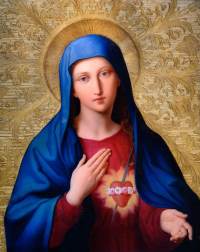
“First of all, it’s important to take account of the fact that the World Youth Days don’t consist just of that one week which is visible to the world,” Benedict said. [A fair point.] “There’s a long path, exterior and interior, that leads to it. The Cross, accompanied the image of the Mother of the Lord, makes a pilgrimage through the nations. [Right. But this is not very publicized.] The faith, in its own way, needs to be seen and touched. The encounter with the Cross, which is touched and carried, becomes an interior encounter with Him who died on the Cross for us. [This has been at the core of my own theological approach to liturgy….]The encounter with the Cross awakens in the intimacy of the young people the memory of that God who wanted to become human and suffer for us. We also see the woman that He wanted as his mother. The solemn days are simply the culmination of this long journey, with which the young people meet one another and move together towards meeting Christ.”
“In Australia, it wasn’t an accident that the long Via Crucis through the city becoming [WYD is still developing] the culminating event of these days,” the pope said. “It expressed anew all that had happened in the preceding years, and pointed to Him who brings all of us together: that God who loves us all the way to the Cross.”
“Thus, the pope is not the star around which everything turns. He is totally, and solely, the Vicar. [NB: Vicar of Christ… not of Peter.] He points to the Other who stands in our midst.”
“In the end, the solemn [? … ugh] liturgy is the center of the gathering, because in it everything happens that we can’t accomplish on our own, and for which we are always waiting,” the pope said. “He is present. He enters in our midst. Heaven is opened, and this makes the earth luminous. This is what makes life joyful and open, and what unites us one with another in a joy that cannot be compared to the ecstasy of a rock festival.” [I am waiting for WYD liturgies to become truly solemn, in a deeper sense than just "important".]
“Friedrich Nietzsche once said: ‘Success does not lie in organizing a party, but in finding people capable of drawing joy from it.’ According to Scripture, joy is a fruit of the Holy Spirit (Gal 5:22), and this fruit was absolutely palpable during those days in Sydney.” [subjective… but fair, I guess.]
“Just as a long journey precedes World Youth Day, a succeeding path is also derived from it,” Benedict said. “Friendships are formed that encourage a different style of life, and that sustain it from the inside. These great days have, not last, the aim of inspiring such friendships and nurturing places of life in the faith in the world, which are at the same time places of hope and of lived charity.” [Time will tell.]
The Environment
In a similar vein, reflection on the Holy Spirit also led Benedict to underscore the Christian concern for the environment.
“Faith in the creator Spirit is an essential component of the Christian creed,” the pope said. [Creatio ex nihilo set us apart from all other religions.] “The ultimate basis for our responsibility towards the earth lies in our faith regarding creation. It is not simply our property, which we can exploit according to our own interests and desires. It is instead the gift of the Creator, with certain intrinsic rules [This "rules" point might be a good point of differentiation from secular or gnostic environmentalist types.] that offer us an orientation we must respect as administrators of creation.” [Interesting… another theme is, perhaps, mediation.. our secondary role, … Pope as Vicar of Christ, we are stewards. It is about us, but not about us. There are logical distinctions to be made.]
The pope insisted that the church must get involved in today’s environmental debates. [I agree.]
“Because faith in the Creator is an essential part of the Christian creed, the church cannot and must not limit itself to transmitting only the message of salvation to its faithful,” Benedict said. “It has a responsibility for creation, and must express this responsibility in public.” [This is a key to what Pope Benedict is trying to accomplish in his pontificate. The Catholic Church and her faithful must have a voice in the public square on all those things touching also the human experience. But in order to have something to contribute, we have to know who we are and what we believe and we must live it.]
At the same time, Benedict clearly distinguished the church’s approach from secular environmental movements – insisting that concern for tropical rain forests and the church’s traditional pro-life commitments, including sexual morality, are indissolubly linked.
“[The church] must defend not only the earth, water and air as gifts of creation that belong to all,” he said. “It must also defend the human person against its own destruction. [In the Christian vision, man is at the summit of material creation and not separate from it. The materialists and gnostics too often oppose man a creation, as if we were opponents.] What’s needed is something like a ‘human ecology,’ understood in the right sense. It’s not simply an outdated metaphysics if the church speaks of the nature of the human person as man and woman, and asks that this order of creation be respected.” [He spoke of "rules" and now of "order".]
“Here it’s a question of faith in creation, in listening to the language of creation, [Interesting. The Pope seems almost to be saying that the Logos echoes in creation, and we can discern its language. Sure there are therefore rules and order.] disregard of which would mean self-destruction of the human person [because we are going against ourselves] and hence destruction of the very work of God,” [who created ex nihilo] the pope said. “That which is often expressed and understood by the term ‘gender’ in the end amounts to the self-emancipation of the human person from creation and from the Creator. [Excellent. Part of the order, with the rules that come from order, in the "language" the Divine Logos as the one through whom all things were made, includes real differentiation.] Human beings want to do everything by themselves, and to control exclusively everything that regards them. But in this way, the human person lives against the truth, against the Creator Spirit.” [There must be a submission to reality or we do ourselves harm.]
“Yes, the tropical forests merit our protection, but the human being as a creature merits no less protection – [more, rather] a creature in which a message is written which does not imply a contradiction of our liberty, but the condition for it,” the pope said. [Interesting. The image of God in is is a "message". We are back to language. What comes to mind is the language of the human genome, the codes in our fabric. But there is a language, a logos in its deepest sense, behind the codes.]
On that basis, Benedict offered a defense of traditional marriage and Catholic sexual morality. [Because here the differentiations and complementarities come together. Keep in mind the folly being discussed at the UN. The Holy See reacted that that and the secular press went after the reactions.]
“Great Scholastic theologians defined marriage, meaning the lifetime bond between a man and a woman, as a sacrament of creation, which the Creator instituted and which Christ – without changing the message of creation – [There it is again: "message" of creation.] then welcomed into the story of his covenant with humanity,” the pope said. “This witness in favor of the Creator Spirit, present in the nature of this bond and in a special way in the nature of the human person, is also part of the proclamation which the church must offer. [In the public square!] Starting from this perspective, it’s important to re-read the encyclical Humanae Vitae : [40 years after…] the intention of Pope Paul VI was to defend love against treating sexuality as a kind of consumption, the future against the exclusive demands of the present, and the nature of the human being against manipulation.”
Christ and the Church
Later in the address, Benedict offered two other implications of faith in the Holy Spirit with important implications for Catholic theology: the Holy Spirit, he said, cannot be separated from Christ or from the church. [Is this happening? I don’t mainstream Catholics consider the Holy Spirit as much as, say, charismatics do. But is there a "separation"?]
In that regard, Benedict quoted his great intellectual patron, St. Augustine: “Do you too want to live in the Spirit of Christ? Then be in the Body of Christ,” meaning the church. [A pneumatological core of a Catholic eccelsiology? Related to Christology in what way? Is the Holy Father proposing looking for a link in the language of creation itself, the mesage of creation?]
In recent years, the Vatican has sometimes accused some theologians working in the field of inter-religious dialogue of pressing the idea of the Holy Spirit’s presence in non-Christian religions too far, as if the Holy Spirit acts apart from any explicit connection with Christ or the Christian church. While non-Christians may be saved, [Right… this is soteriological…] Vatican authorities have insisted, that does not mean they are not in some sense “oriented” towards Christ and the church – a point, they have suggested, with important consequences for Christian missionary efforts.
Excellent work, John. Good summary.