Here is a nice follow up story to what I posted the other day about the implementation of Summorum Pontificum in the area of Davenport, Iowa.
The following is from The Catholic Messenger with my emphases and comments.
Tridentine Mass returns to diocese
By Celine Klosterman[Photo: Father Scott Lemaster celebrates the first Tridentine Mass at St. Anthony Church in Davenport Aug. 3. Another Mass was celebrated at St. Wenceslaus Church in Iowa City the same day.]
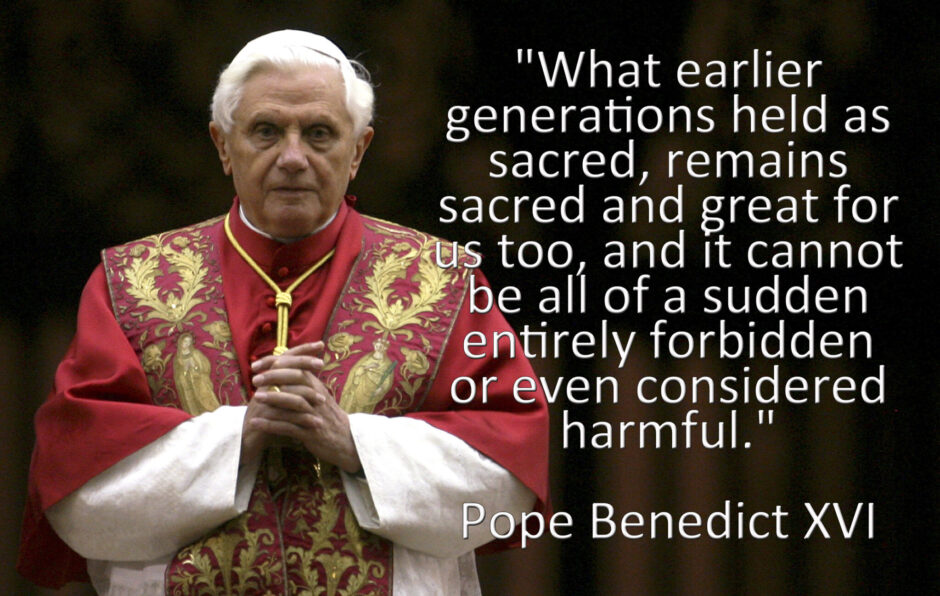
More than 400 people combined attended the first two Tridentine [They need a new term here, but let that go for now.] Masses held in the Diocese of Davenport since last summer, when Pope Benedict XVI issued his apostolic letter that relaxed restrictions on use of the Mass.
Fathers Scott Lemaster and Paul Appel celebrated the Aug. 3 services at St. Anthony’s in Davenport and St. Wenceslaus in Iowa City, respectively. A diocesan survey [intriguing] found that the Iowa City and Davenport areas expressed the greatest interest in celebrating the Tridentine Mass.
“For many years we have waited for our eyes to see and our ears to hear what we see and hear today — the Mass of the ages,” Fr. Lemaster told more than 200 people at St. Anthony’s.
“So many people have wanted this Mass,” said Fr. Paul Appel to about 220 Catholics in his sermon at St. Wenceslaus. He’s one of six diocesan priests who will take turns celebrating Mass according to the 1962 Roman Missal. [If they are pastors, they can do this in their parishes as well.]
His sermon and readings of Scripture were the sole English-language portions of the service, at which people of all ages followed — or attempted to follow — the Mass in booklets featuring both Latin and its English translation.
Because of the language and “silence” of the Tridentine Mass, “you have to work harder, but I think that’s good,” said Fr. Appel. “You have to pay full attention.” [Yes… this is full, conscious and active participation desired by the Second Vatican Council’s Sacrosanctum Concilium.]
Besides the language difference, other notable contrasts from the ordinary form of the Mass were the absence of lay Eucharistic ministers, lectors and female altar servers; the general silence of the congregation; the choir’s embrace of Gregorian chant; and reception of Communion on the tongue, not in the hand.
The richness and defining characteristics of the Tridentine Mass, also known as the Latin Mass, helped Fr. Appel feel drawn to it, though it made up only a fraction of his post-Vatican II priestly formation, he said. To prepare to preside at Tridentine services, he joined other diocesan priests in traveling to Chicago for training through the Canons Regular of St. John Cantius.
“Let us pray for all those who didn’t get to see this day,” he said during his first celebration of the Latin Mass. He voiced hope that those attending would “find something profound and wonderful, that draws you closer to Christ.” [THAT’s the point! Good!]
“This is so reverent,” said Anna Kane of Cedar Rapids after Mass in Iowa City, one of several women who wore a head scarf, or mantilla, to St. Wenceslaus or St. Anthony.
“It puts concentration on the fact that we honor Christ at the altar,” said Peter Kennedy, a St. Wenceslaus parishioner. “And the Latin hymns create a sense of solitude and peacefulness.” [I wonder if "solitude" here isn’t really a way of trying to say "stillness" or "quiet", rather than isolation. The older form of Mass most certainly also can create a sense of broad solidarity as well.]
He and Kane, who each have lived or traveled in Europe, also voiced appreciation for the universality of Latin Mass. “You can go anywhere and it’s the same,” said Kane.
“Deo gratias,” said Teresa Oltman of Geneseo, Ill., thanking God after attending Mass at St. Anthony with family. Her family has attended Latin Mass [Another bad term. Some more catechesis is needed here.] for the past 10 years in the Chicago and Peoria, Ill., areas, but “we finally have a place that is close,” Oltman said. Geneseo is about a 30-minute drive from Davenport.
The Tridentine Mass “is more proper,” said Michael Smith of Monticello, who with his four sons was an altar server at St. Wenceslaus. He wanted his sons to be trained to serve at Latin Mass, a Mass he predicted “everyone will be doing eventually.”
“Maybe someday we’ll get ambitious and do even funeral Masses” in the Latin rite, [Let me go out on a limb here, but I predict that they will be needed.] said Tom Rowland, who helped coordinate preparations for St. Wenceslaus’ service. He said he was pleasantly surprised by turnout at that Mass, having expected to see only half the number who showed up. “I think a lot of people are interested in this,” he said, noting he’s still getting e-mails from people wanting to help with the Mass.
“It will be interesting to see how many people continue coming” after the novelty wears off, he added. “This will click with a lot of people; with others it won’t.”
Still, he said, “I couldn’t be happier about the way things went today.”
Tridentine Masses will take place every Sunday at 1:30 p.m. at St. Wenceslaus and 4 p.m. at St. Anthony, and on the third Sunday of each month at 1 p.m. at Ss. Mary & Joseph Parish in Sugar Creek.
(Anne Marie Amacher contributed to this story.)
 Tridentine Mass returns to diocese