I love the fact that we have a human dimension to Holy Church. We are a Church of flawed sinners, of weak people susceptible to the attacks and problems of the world the flesh and the devil. Our Lord gave us sacraments which are administered by fragile human beings.
But it all works.
Here is a question from a reader:
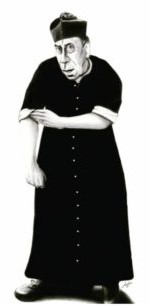
“I went to confession recently, and during which, the (older) priest asked me to speak louder. So I did, and repeated my sins. At the end of my part of the confession, he said “I’m really having trouble hearing you.” I asked him: “OK, what have you heard so far, then?” and he responded “Not a whole lot.” Then I asked him if I should repeat myself, and he said “No,” and continued, “your penance is x…”
Was that a valid confession?”
In my opinion you were validly absolved, provided you confessed all your mortal sins with sincere sorrow.
All sacraments have matter and form. In the Sacrament of Penance, the form is the proper form of absolution and the matter is the telling of the sins. You told your sins. The priest didn’t hear nothing. Even if he heard little, or understood little, he could still absolve you. In a similar way, a confessor can absolve a penitent speaking another language even without an interpreter helping or without pointing to numbers of the commandments, etc.

CLICK TO BUY U.O.M. STUFF
Since I am an Unreconstructed Ossified Manualist, I check a couple manuals. Without going into a long explanation of “remote and proximate matter”, it seems to me that there was sufficient matter in this case. Prümmer puts it succinctly enough:
Cum autem in iudicio paenitentiali ipse Deus, perscrutator cordium, si principalis iudex, et finis istius iudicii sit sententia reconciliatoria et liberativa, non requiritur, ut confessarius perfecte cognoscat delicta paenitentis. [emphases in the original]
…
But since in penitential judgment God Himself, the thorough examiner of hearts, is the principle judge, and the end of this judgment is a reconciling and freeing judgement, it is not required that the confessor knows perfectly the penitent’s sins.
Furthermore, fear of being overheard is, in part, an excusing factor when it comes to material integrity of the confession.
I think you can be at ease about what happened.
I am sure you don’t want to have to shout and, perhaps, be heard by others who are waiting in line. Thus, in order to avoid this in the future, if this is your only confessor anywhere near you, then you might either make an appointment or even consider writing things down for him to read if he can’t hear.
Either way, keep going to confession regularly.
A little embarrassment from perhaps being in part overheard is better than dying and going to your judgment unshriven!
NOTE TO BISHOPS, PRIESTS, AND TRANSITIONAL DEACONS (lay people, skip over this part o{];¬) ): May I suggest, Fathers, that you find an old manual, yes, one of the old Latin manuals, and – if you don’t know Latin getting help from a priest who does – go through the section on the Sacrament of Penance? Some of the juridical points about faculties and when and when confessions can be received have changed, but the theology is still pertinent. In my opinion, we need to refresh ourselves on this sacrament. Pay special attention, dear Fathers, to our obligation to teach people that they must confess all their mortal sins in kind and number. When you read these old manuals, you find the theological reasons for this as well as the urgency of the necessity. Don’t assume that you have all this down cold. We all need reviews. When I pick up one of these old books, I learn or relearn something interesting and useful.
Okay, lay people, you can start reading again.
Everyone, go to confession. Even if it has been a long time, or you don’t like the priest, or you have embarrassing things to confession, or you are afraid, or you are lazy… go to confession.
Most parishes offer opportunities for confession on Saturdays.
Make a plan.
GO TO CONFESSION!