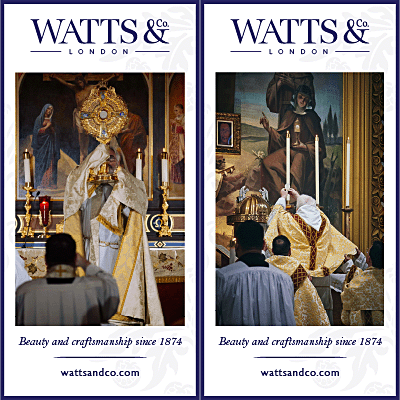
Papa was once again in the taglio filipino vestments for the Holy Mass in the Basilica this morning.

What in Italian is called the "taglio filipino" is so named after St. Philip Neri, who is depicted in paintings in this type of vestments.
This is the style of vestment in use around the time of the Council of Trent, worn by figures such as St. Ignatius of Loyola.

It is emblematic of a age in the Church’s life, a period of Counter-Reformation, when there was an explosion of lay confraternities seeing to spiritual and corporal works of mercy at every level of society, simply and noble. It is a period of tremendous deepening of our understanding of the Blessed Sacrament and subsequent development of devotions, such as Exposition, Benediction, and increase in observance of 40 Hours, devotion to the Sacred Heart. This was an era of change in architecture, when the Roman baroque came into its own as an outward, concrete, plastic expression of the Church’s own self-understanding, her ecclesiology.
It was a time when the humanities were in harmony with theology.

This style of vestment is the first stage of development between the fuller "cloak" style chasuble of the Medieval period and the later Roman vestment, which is smaller and more squared in the back and front. for example, not only is the "Philip" style longer in front and back, and curved at the bottom, but it also comes farther down the shouders than the modern Roman vestment.

Thus it is a concrete symbol of continuity between two great Catholic eras.
WDTPRS has asserted again and again that Papa Ratzinger is saying something through his vestments. He mixes them up a bit, but he keeps coming back to this important taglio filipino. Some will try to brush this off, or relegate his choice to a matter of mere personal taste.
I say that the very vestment is an icon of what Benedict is proposing: a hermeneutic of reform rather than of rupture. Benedict is signaling the great value of the period of the style vestment as well as the fact that it is a harmonious bridge between two fantastic periods of Catholicity. Benedict is healing the rupture that occurred in liturgy in many ways, with Summorum Pontificum, certainly, but also in the accoutrement of celebration, such as the placement of candles and the altar Cross.
The other day the Pope’s MC, Msgr. Guido Marini, gave an interview to Andrea Tornielli of Il Giornale. In that interview he said:
"The vestments chosen, as also other particulars of the Rite," the Master of Ceremonies explained, "are intended to underscore the continuity of the present liturgical celebration with that which characterized in the past the life of the Church. Continuity is the interpretive key, always the exact criteria for reading the Church’s journey through time. This is valid also for liturgy." "As one Pope cites in his documents the Pontiffs who preceed him, so as to indicate the continutiy of the Magisterium of the Church," Marini continues, "so in the ambient of liturgy a Pope uses also the vestments and sacred accoutrement of his precedessors to show the same continuity also in his celebratations. …