From a reader:
You recently had a post about Latin and the Novus Ordo with a
reference to canon 928. You asserted that Mass can always be
celebrated in Latin based on that canon. If one’s bishop makes it a
policy that priests who want to have a Mass (with a Congregation) in Latin must obtain permission from him, is this a legitimate exercise of his authority?
I took this to a trusted canonist and received back this response which I have edited slightly and to which I have added some emphases and notes of my own:
Before we address the matter, we need to know precisely what the situation is. A bishop has made this “a policy.” How did he do so? Did he simply state to the priests that this is his preference? Did he issue some sort of a decree? How did he make this “policy” known?
I don’t see how a bishop could legitimately could require that priests get his permission to celebrate the liturgy publicly in the normative language of the Rite. [Exactly.] If it were merely stated as a “policy,” any priest should feel completely free to disregard it, as “policies” have no real force in law. If it was issued as a decree, then the priest could – and should [!] – seek administrative recourse, first asking the bishop to reverse the decree, and then pursuing the matter before the Congregation for Divine Worship. I am certain he would obtain a favorable hearing. [Haudquaquam dubitandum’st!]
We also need to know precisely what the policy states. The bishop is, legitimately, the moderator of the liturgy in his diocese. He has an obligation to see to the legitimate needs of the faithful under his care.
[Let the fun begin!] The allowance of the vernacular in the liturgy has given rise to the legitimate aspirations of the faithful to have the liturgy celebrated – at least in part, and at least some of the time – in the vernacular.
If, say, there is a town with three parishes, and all three parishes offer Holy Mass each weekend only in Latin – two in the Ordinary form and one in the Extraordinary Form – and there is a coetus of people who wish to have Mass celebrated in the vernacular, [LOL!] it would be reasonable for the bishop to step in and require that one of the parishes have one Mass on the weekend in the vernacular. Perhaps at 3:00 p.m. in the afternoon, in a side chapel, after the heat in the church has been turned off, and while the janitor is cleaning the rest of the church with a loud buffer. (a bit too snarky?) [Noooooooo…..]
On the whole, however, I wish that bishops spent as much time and energy eliminating real liturgical abuse as they seem to spend on making some legitimate options mandatory and others verboten.
How strenuously does this bishop enforce a “policy” against the abuse of General Absolution, or stoles being worn over chasubles, or the use of extraordinary ministers when none are warranted?
Superb.
What many people don’t realize is that the Second Vatican Council mandate that Latin be retained in the Latin Church’s liturgical worship (SC 36.1). It said that the vernacular could be used at times for some parts of the Mass (SC 36.2).
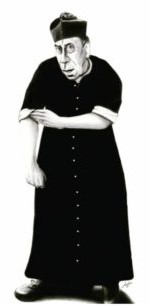
In other words, the esteemed canonist, in his Rod Serling-esque response (above) hit the right tone.