I found a rather interesting story in the St. Louis Review Online.
My emphases and comments.
January 11, 2008
Vocations: Kenrick-Glennon seminarians train to meet faithful’s liturgical needs
by Jennifer Brinker, Review Staff Writer
It’s important for the Church to meet the faithful where they are [Speaking psychogeographically, of course.] in their lives, say those involved in the formation of tomorrow’s priests.
The liturgy is one such area of importance to Catholics. [Perhaps the most important aspect.] And whether the faithful, for example, prefer a Mass in English or Spanish, or have a liking for the traditional Latin Mass, the future priests at Kenrick-Glennon Seminary are becoming well-equipped to minister to them.
"A priest needs to be able to minister to whatever culture he serves," noted Msgr. Ted L. Wojcicki, president-rector of Kenrick-Glennon Seminary. "We’re training seminarians to be understanding of the culture in which people live and to proclaim the Gospel to them. It’s important to understand the people, whatever their culture is, and to preach the Gospel in whatever way touches and challenges their hearts."
Seminarians currently learn several ways to celebrate the Mass, including in the extraordinary form, commonly known as the traditional Latin Mass, and the ordinary form, also known as the Novus Ordo, in both English and Latin. They regularly celebrate Mass in Spanish, too.
Instructing seminarians in the liturgy is just one part of the job for Father Thomas G. Keller, director of worship at Kenrick-Glennon. The priest oversees efforts to teach seminarians about all of the sacraments, as well as eucharistic adoration, the Rosary and other devotional prayers and activities.
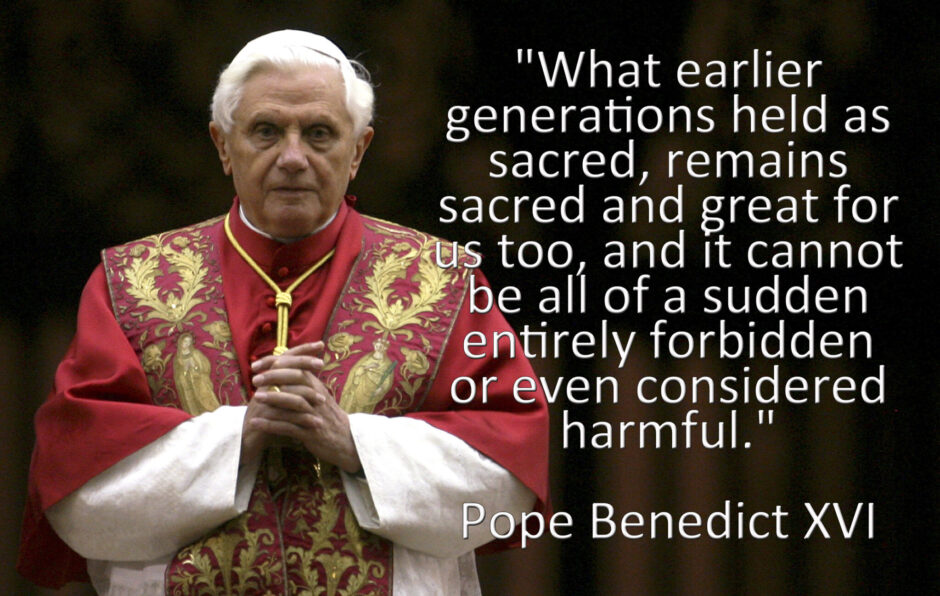
Last semester, Father Keller began offering training to seminarians in the traditional Latin Mass. The effort is a response to Pope Benedict XVI’s apostolic letter, "Summorum Pontificum," released last year and which allows for greater use of the Tridentine Mass.
"We have Mass twice a month in the extraordinary form, and the largest component is exposure as time goes on," said Father Keller. "The students who are closer to ordination will be given one-on-one training — as they are with the ordinary form of the Mass — to understand the rubrics and the customs and spirit of the liturgy."
The priest, who was ordained in 1997 and born well after the Second Vatican Council, said he, too, is new to the Tridentine Mass. Last summer, he visited the seminary of the Institute of Christ the King Sovereign Priest, in Gricigliano, Italy, where he learned how to celebrate the extraordinary form of the Mass. He also has been assisting the institute’s priests at St. Francis de Sales Oratory in South St. Louis and the Benedictine priests and brothers at Oratory of St. Gregory the Great and St. Augustine of Canterbury at the Abbey of St. Mary and St. Louis in Creve Coeur."I have been extremely surprised and pleased with the beauty of the liturgy," said Father Keller. "It’s a different liturgical calendar and rubrics and language."
However, he added that "this is not designed to overthrow the ordinary form in which people worship, but to respond to the additional needs of the faithful."
Transitional deacon Michael Houser, a fourth-year theology student at Kenrick-Glennon, is one example of seminarians who have taken an interest in learning the traditional Latin Mass. Rev. Mr. Houser, who is serving his transitional diaconate assignment at St. Margaret Mary Alacoque Parish in Oakville, said he first was exposed to the traditional Latin Mass as a graduate student at Franciscan University of Steubenville in Ohio. [Where, of course, there isn’t one. Rather, students have to go to a nearby parish.]
"I think one of the things that attracts me to the extraordinary form of the Roman rite is the amount of significance that this rite has had in the history and tradition of the West," he said. "Just about every saint in our Catholic tradition, going back to the Council of Trent, celebrated this Mass or something similar. It’s important for me to have contact with this form of the Mass that was so very dear to our saints."
With his anticipated ordination for the St. Louis Archdiocese this May, Rev. Mr. Houser said that realistically he believes his ministry as a priest will focus on celebrating the ordinary form of the Mass in English. But he said he’s very encouraged by the Holy Father’s issuance of "Summorum Pontificum" and plans to celebrate the traditional Latin Mass in private celebration "and also when there might be a pastoral need for that to be offered."
Another area in which seminarians are being prepared for the priesthood is by learning about the Hispanic culture, along with a regular celebration of Mass in Spanish. Father Randy Soto, an associate professor of Scripture and native of Costa Rica, oversees Hispanic ministry efforts at Kenrick-Glennon.
"During their (Cardinal Glennon) College program, they choose their language track," he said. "They are required to take a modern language, and most will take Spanish. Some will take French or German." Once seminarians enter Kenrick School of Theology, they are presented with several opportunities to prepare themselves for Hispanic ministry.
One such example is that the Mass is celebrated in Spanish every Tuesday in the seminary’s main chapel, said Father Soto.
"The men get to be readers, cantors, acolytes and deacons," he said. "They get to serve the Mass totally in Spanish. The only thing that is in English is the homily." Certain feast days of importance to Hispanics, such as Our Lady of Guadalupe and the Day of the Dead, or All Souls Day, also are celebrated at the seminary.
Father Soto also teaches a Hispanic ministry class, in which he shows seminarians "how to engage in Hispanic ministry in the parishes.
"The seminarians get to prepare presentations on every country in Latin America. They get to know all of the different subcultures of the Hispanic culture. We teach them grammar in Spanish, but the orientation will be more liturgical Spanish."
In addition, third-year theology students are sent to a seven-week immersion program in Mexico City. During that time, they learn the language and cultural differences and serve in local parishes. Kenrick-Glennon began offering that program two years ago, said Father Soto.
Some theology students, as part of their parish assignments, will go to local parishes that offer Hispanic ministry, such as St. Cecilia in South St. Louis, Our Lady of Guadalupe in Ferguson and Holy Trinity in St. Ann. "They get experience on a weekly basis in Hispanic ministry," said Father Soto.
Transitional deacon Scott Hastings, a fourth-year theology student, said his training in Hispanic ministry will be very beneficial when he returns to his Diocese of Omaha, Neb., after his expected ordination in May. Of the roughly 220,000 Catholics in Omaha, Rev. Mr. Hastings said there are roughly 50,000 who are Hispanic.
"That’s about one in four and a half people who are Hispanic," he said. "But that number is grossly underestimated. We have no idea how many truly come in. We have Masses where people will stand outside" because of a lack of seating in the church. "We sometimes have 200 people waiting to come in and go to Communion."
Deacon Hastings currently is serving his transitional diaconate assignment at St. Cecilia, where he noted the two Masses in Spanish at 10:30 a.m. and noon are "absolutely full." He also has assisted at other parishes that have a significant Hispanic membership, including Holy Trinity, St. Charles Borromeo in St. Charles and St. John the Baptist, where he taught at the parish high school.
"Oftentimes, there is an assumption that the Church doesn’t have an obligation to people who speak Spanish," said Rev. Mr. Hastings. In today’s ministry to Hispanics, for example, "the children I teach in school are not quite bilingual," he noted. "What we’re seeing is a shift, but it’s unreasonable to think that we wouldn’t offer things in another language.
"The choice to do Hispanic ministry or the traditional Latin Mass is often taken as an idea that one (form) is better than another. But that is simply not the case. The Church is a large place, and it’s very important to meet people where they are. And people are in very different places."