 Today in the older, venerable, traditional Roman calendar, is the feast of St. Monica, widow and mother of St. Augustine of Hippo. In the post-Conciliar calendar her feast was transferred to the end of August. Monnica, is a spelling that conforms to her Punic origin.
Monica died at Rome’s port Ostia, prevented from her return to N. Africa by a naval blockade. She caught a fever and passed away in 387, saying,
“Bury my body wherever you will; let not care of it cause you any concern. One thing only I ask you, that you remember me at the altar of the Lord wherever you may be.”
Much of St. Monica’s life is described by Augustine in Book 9 the Confessions. There are moving passages about her overcoming an addiction to alcohol, her dealings with a difficult and violent husband whom she helped to convert, her perseverance in promoting her son – whom she insisted be given the imperial name Augustus – and her good death. Augustine had her buried in Ostia and had a stone set up for her. After the sack of the area by the Visigoths in 410, he wrote to have her stone renewed. Though her body was subsequently moved to the Church of St. Augustine in Rome, her stone was discovered after WWII by children trying to set up a basketball hoop, a game they learned from American GI’s.
After Augustine ditched her in N. Africa to go alone to Italy, but she soon followed. In Milan, Monnica had some dealings St. Ambrose concerning her use of N. African customs in N. Italy, which scandalized people. He instructed her to do as they did and gave her the example of his own willingness to conform to the customs of Rome when he was in Rome. Whence the famous proverb. She must have been a formidable woman to have garnered attention from Ambrose. Furthermore, Augustine himself gives her an important role in his early philosophical dialogues, an unprecedented role for a woman in ancient literature. As Augustine and his companions were preparing for baptism during their working retreat at Cassiciacum, Monica would sometimes be asked – as the baptized person present to answer certain questions. She, therefore, exemplified something of Augustine’s homo spiritalis he would develop later, a figure who might even correct a bishop.
In life, Monica was a fascinating woman, a loving wife and mother, and after death a strong intercessor.
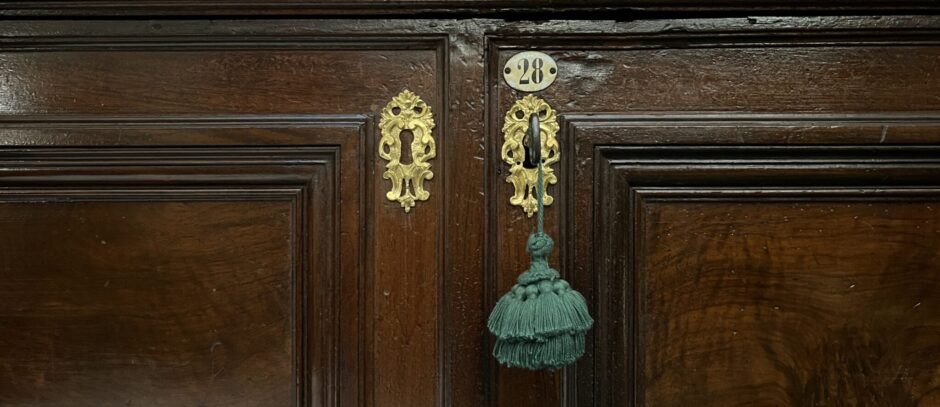
Here is a photo of a first class relic of St. Monica, in my possession.

Today is also the feast of several English martyrs.
Who would like to have a go at this entry from the 2005 Martyrologium Romanum?
6. Londinii in Anglia, sanctorum presbyterorum martyrum Ioannis Houghton, Roberti Lawrence et Augustini Webster, priorum cartusiarum Londiniensis, Ballavallensis et Axholmiensis, atque Richardi Reynold, ex Ordine Sanctae Brigittae, qui, cum fidem patrum impavide professi essent, Tyburni ad supplicium laniatus tracti sunt sub Henrico rege Octavo. Cum eis beatus Ioannes Haile, presbyter, parochus loci Isleworth prope urbem, eodem patibulo suspensus est.