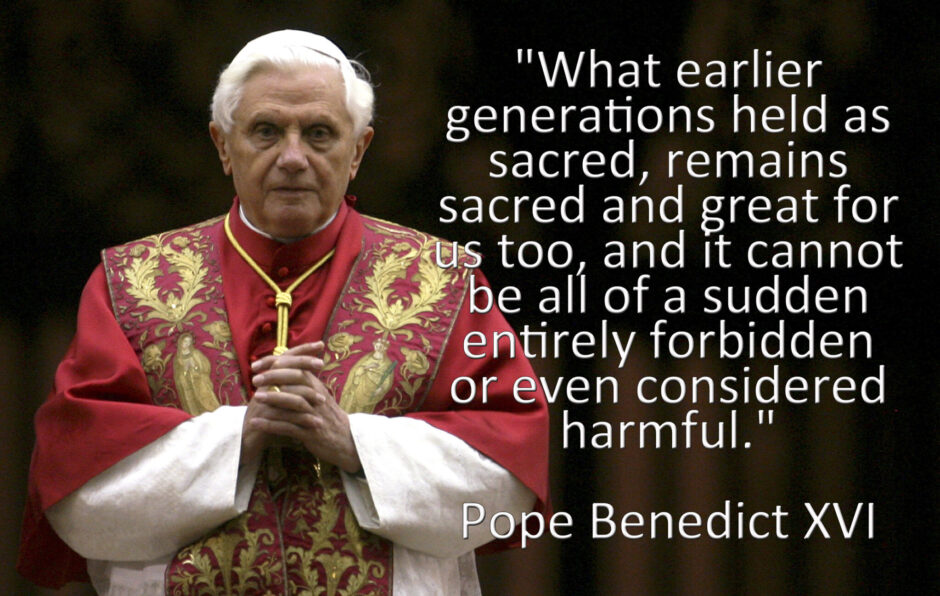
Thanks to be to Pope Benedict, who has given back to the Church and the world a great gift. As one friend put it, the world has been made just a little bit safer to live in. This document is about opening hearts and healing. In his explanatory letter Pope Benedict even quotes 2 Cor 6:13: “Widen your hearts!” Read Summorum Pontificum with a wide heart, and no one need fear that rights will be trampled or due authority undermined. The Motu Proprio goes into effect on 14 September. We have time to chew and digest, collect things and make arrangements. We must not jump the gun. But we can make a start. What this Motu Proprio does Effectively it levels the playing field for people who want to use the older liturgical forms. Remember: the MP applies to all the sacraments as they were before the Council, not just Holy Mass. It concerns the liturgy, not just Holy Mass. Thus clerics (bishops, priests, deacons), who are obliged to recite the Liturgy of the Hours can use the older Breviarium Romanum as it was in 1962. Benedict is establishing the older form of liturgy, as in was in 1962, as an extraordinary form (forma extraordinaria). The Novus Ordo of the Roman Missal and all other liturgical books remain the ordinary way of celebrating the liturgy. "Extraordinary", here, does NOT mean "rare" or "unusual" or "special". It simply means "out of the common order". If we turn to how the Church uses Latin in, for example, a pretty good Latinist, St. Jerome, the adverb extraordinarie means "with excessive frequency" (cf. On Ephesians 1 ad. 2, 13). It cannot be argued legitimately from the word "extraordinary" that use of the older forms must necessarily be "rare". It can be quite regular, depending on the circumstances, while in the larger scheme of things the Novus Ordo remains now the usual way things are done. The Motu Proprio responds to THREE GROUPS of people: 1) Followers of the SSPX, for whom this form of Mass is a "mark of identity", even though there are also deeper theological reasons for that break. 2) There are many lay people who also remember the older form of Mass from before the changes. And you don’t have to be to 80 to remember those days. There are people in the 40’s and 50’s who remember living with the old Mass. They have always remained attached to the old Mass or have regained a longing for it. 3) There are those who were neither in a separated group nor remember the pre-Conciliar Mass. These are younger people who have discovered the older form. As a result, it is unacceptable to suggest that these provisions were made merely to accomodate a bunch of nostalgic old foggies who can’t get with the program. The provisions were made with anyone in mind who wants older forms, for any decent reason. People who want to avail of this extraordinary use are not second rate citizens. They may not be treated any longer like the nutty aunt in the attic. There are a few things to dispell.
- In the explanatory letter the Pope invites bishops, "I invite you, dear Brothers, to send to the Holy See an account of your experiences, three years after this Motu Proprio has taken effect. If truly serious difficulties come to light, ways to remedy them can be sought." This does NOT impose an expiration date. What it does is ask for information about what is going on. If, in light of experience, the provisions need to be changed, they can be changed based on experience. However, I hasten to point out to the whiners who will say this weakens the Motu Proprio, that this invitation is NOT in the Motu Proprio itself. I will remind those who see the glass always as half empty that if the experiences are POSITIVE, the provisions could be adjusted positively. So, in a way, it is up to you. Open hearts. Work together. Save the Liturgy – Save the World, as we say around this blog.
- The bishops retain authority in their dioceses. Can it be any other way? This is entirely normal, good and proper. However, the Pope has with this Motu Proprio made many things that were once rather vague far more concrete and clear. Remember, bishops can be allies. You must approach them properly, which is only common sense. It may be that Fr. Guido O’Brien at St. Ipsydipsy doesn’t want to or in incapable of celebrating Mass in the old way. In that case, the bishop could be helpful in resolving the dilemma.
- Private Masses/liturgies in the old form can’t be celebrated in private in the Triduum. That is normal and reasonable. that is the way it is in the Novus Ordo. In places where the older form is established in a parish for the older use, the Triduum CAN be celebrated with the older books. However, in parishes where the newer forms are the usual fare, and there is a regularly scheduled Mass with the older form, when the Triduum arrives, the older, extraordinary liturgy must give way to the ordinary. That is logical. In the Novus Ordo, as in the older days, there cannot be two Masses of the Last Supper on Holy Thursday, two Good Friday liturgies, or two Vigils. So, in this case, the ordinary takes precedence.
- The issue the Triduum and this reasonable restriction has nothing to do with the prayer about the Jews on Good Friday. This is simply a matter of what the Church’s logical practice is based on the sacred nature of those Triduum liturgies. The Jews were not part of the equation. Remember also that the 1962 Missale Romanum is used for the Triduum in those places where it will be permitted to use the older form at that time. The 1962 edition and not some earlier edition before the changes to those Good Friday petitions.
- As stated above, the 1962 Missale, the Missal of Bl. John XXIII is to be used, and NOT some earlier edition. Priests who are not adhering to the 1962 rubrics should be now ready and willing to adjust what they are doing. Lay people must be ready and willing to adjust their expectations.
- The Motu Proprio does NOT set a minimum number of people who must ask for the older form of Mass before it can be conceded. It does talk about stable groups for regularly scheduled Masses.
Remarkably, on the Vatican website only the LEGAL section (second part) of the Motu Proprio is rendered into ENGLISH. Here it is: Link to Vatican site The Explanatory Letter.
Attenzione: è stata tradotta solo la parte dispositiva del Motu proprio Summorum Pontificum (…….) … Our predecessor John Paul II having already considered the insistent petitions of these faithful, having listened to the views of the Cardinal Fathers of the Consistory of 22 March 2006, having reflected deeply upon all aspects of the question, invoked the Holy Spirit and trusting in the help of God, with these Apostolic Letters We establish the following: Art. 1 The Roman Missal promulgated by Paul VI is the ordinary expression of the Lex orandi (Law of prayer) of the Catholic Church of the Latin rite. Nonetheless, the Roman Missal promulgated by St. Pius V and reissued by Bl. John XXIII is to be considered as an extraordinary expression of that same Lex orandi, and must be given due honour for its venerable and ancient usage. These two expressions of the Church’s Lex orandi will in no any way lead to a division in the Church’s Lex credendi (Law of belief). They are, in fact two usages of the one Roman rite. It is, therefore, permissible to celebrate the Sacrifice of the Mass following the typical edition of the Roman Missal promulgated by Bl. John XXIII in 1962 and never abrogated, as an extraordinary form of the Liturgy of the Church. The conditions for the use of this Missal as laid down by earlier documents Quattuor abhinc annis and Ecclesia Dei, are substituted as follows: Art. 2 In Masses celebrated without the people, each Catholic priest of the Latin rite, whether secular or regular, may use the Roman Missal published by Bl. Pope John XXIII in 1962, or the Roman Missal promulgated by Pope Paul VI in 1970, and may do so on any day with the exception of the Easter Triduum. For such celebrations, with either one Missal or the other, the priest has no need for permission from the Apostolic See or from his Ordinary. Art. 3 Communities of Institutes of consecrated life and of Societies of apostolic life, of either pontifical or diocesan right, wishing to celebrate Mass in accordance with the edition of the Roman Missal promulgated in 1962, for conventual or "community" celebration in their oratories, may do so. If an individual community or an entire Institute or Society wishes to undertake such celebrations often, habitually or permanently, the decision must be taken by the Superiors Major, in accordance with the law and following their own specific decrees and statues. Art. 4 Celebrations of Mass as mentioned above in art. 2 may – observing all the norms of law – also be attended by faithful who, of their own free will, ask to be admitted. Art. 5 § 1 In parishes, where there is a stable group of faithful who adhere to the earlier liturgical tradition, the pastor should willingly accept their requests to celebrate the Mass according to the rite of the Roman Missal published in 1962, and ensure that the welfare of these faithful harmonises with the ordinary pastoral care of the parish, under the guidance of the bishop in accordance with canon 392, avoiding discord and favouring the unity of the whole Church. § 2 Celebration in accordance with the Missal of Bl. John XXIII may take place on working days; while on Sundays and feast days one such celebration may also be held. § 3 For faithful and priests who request it, the pastor should also allow celebrations in this extraordinary form for special circumstances such as marriages, funerals or occasional celebrations, e.g. pilgrimages. § 4 Priests who use the Missal of Bl. John XXIII must be qualified to do so and not juridically impeded. § 5 In churches that are not parish or conventual churches, it is the duty of the Rector of the church to grant the above permission. Art. 6 In Masses celebrated in the presence of the people in accordance with the Missal of Bl. John XXIII, the readings may be given in the vernacular, using editions recognised by the Apostolic See. Art. 7 If a group of lay faithful, as mentioned in art. 5 § 1, has not obtained satisfaction to their requests from the pastor, they should inform the diocesan bishop. The bishop is strongly requested to satisfy their wishes. If he cannot arrange for such celebration to take place, the matter should be referred to the Pontifical Commission "Ecclesia Dei". Art. 8 A bishop who, desirous of satisfying such requests, but who for various reasons is unable to do so, may refer the problem to the Commission "Ecclesia Dei" to obtain counsel and assistance. Art. 9 § 1 The pastor, having attentively examined all aspects, may also grant permission to use the earlier ritual for the administration of the Sacraments of Baptism, Marriage, Penance, and the Anointing of the Sick, if the good of souls would seem to require it. § 2 Ordinaries are given the right to celebrate the Sacrament of Confirmation using the earlier Roman Pontifical, if the good of souls would seem to require it. § 2 Clerics ordained "in sacris constitutis" may use the Roman Breviary promulgated by Bl. John XXIII in 1962. Art. 10 The ordinary of a particular place, if he feels it appropriate, may erect a personal parish in accordance with can. 518 for celebrations following the ancient form of the Roman rite, or appoint a chaplain, while observing all the norms of law. Art. 11 The Pontifical Commission "Ecclesia Dei", erected by John Paul II in 1988, continues to exercise its function. Said Commission will have the form, duties and norms that the Roman Pontiff wishes to assign it. Art. 12 This Commission, apart from the powers it enjoys, will exercise the authority of the Holy See, supervising the observance and application of these dispositions. We order that everything We have established with these Apostolic Letters issued as Motu Proprio be considered as "established and decreed", and to be observed from 14 September of this year, Feast of the Exaltation of the Cross, whatever there may be to the contrary. From Rome, at St. Peter’s, 7 July 2007, third year of Our Pontificate.
There are a few difficulties in the English translation, as I compare it to the Latin. The English in a few cases softens what the Latin says. I will be digging into them in other entries.
LITTERAE APOSTOLICAE MOTU PROPRIO DATAE BENEDICTUS XVI SUMMORUM PONTIFICUM cura ad hoc tempus usque semper fuit, ut Christi Ecclesia Divinae Maiestati cultum dignum offerret, «ad laudem et gloriam nominis Sui» et «ad utilitatem totius Ecclesiae Suae sanctae». Ab immemorabili tempore sicut etiam in futurum, principium servandum est «iuxta quod unaquaeque Ecclesia particularis concordare debet cum universali Ecclesia non solum quoad fidei doctrinam et signa sacramentalia, sed etiam quoad usus universaliter acceptos ab apostolica et continua traditione, qui servandi sunt non solum ut errores vitentur, verum etiam ad fidei integritatem tradendam, quia Ecclesiae lex orandi eius legi credendi respondet»1. Inter PontÃfices qui talem debitam curam adhibuerunt, nomen excellit sancti Gregorii Magni, qui tam fidem catholicam quam thesauros cultus ac culturae a Romanis in saeculis praecedentibus cumulatos novis Europae populis transmittendos curavit. Sacrae Liturgiae tam Missae Sacrificii quam Officii Divini formam, uti in Urbe celebrabatur, definiri conservarique iussit. Monachos quoque et moniales maxime fovit, qui sub Regula sancti Benedicti militantes, ubique simul cum Evangelii annuntiatione illam quoque saluberrimam Regulae sententiam vita sua illustrarunt, «ut operi Dei nihil praeponatur» (cap. 43). Tali modo sacra liturgia secundum morem Romanum non solum fidem et pietatem sed et culturam multarum gentium fecundavit. Constat utique liturgiam latinam variis suis formis Ecclesiae in omnibus aetatis christianae saeculis permultos Sanctos in vita spirituali stimulasse atque tot populos in religionis virtute roborasse ac eorundem pietatem fecundasse. Ut autem Sacra Liturgia hoc munus efficacius expleret, plures alii Romani Pontifices decursu saeculorum peculiarem sollicitudinem impenderunt, inter quos eminet Sanctus Pius V, qui magno cum studio pastorali, Concilio Tridentino exhortante, totum Ecclesiae cultum innovavit, librorum liturgicorum emendatorum et «ad normam Patrum instauratorum» editionem curavit eosque Ecclesiae latinae usui dedit. Inter Ritus romani libros liturgicos patet eminere Missale Romanum, quod in romana urbe succrevit, atque succedentibus saeculis gradatim formas assumpsit, quae cum illa in generationibus recentioribus vigente magnam habent similitudinem. «Quod idem omnino propositum tempore progrediente Pontifices Romani sunt persecuti, cum novas ad aetates accommodaverunt aut ritus librosque liturgicos determinaverunt, ac deinde cum ineunte hoc nostro saeculo ampliorem iam complexi sunt redintegrationem»2. Sic vero egerunt Decessores nostri Clemens VIII, Urbanus VIII, sanctus Pius X3, Benedictus XV, Pius XII et beatus Ioannes XXIII. Recentioribus autem temporibus, Concilium Vaticanum II desiderium expressit, ut debita observantia et reverentia erga cultum divinum denuo instauraretur ac necessitatibus nostrae aetatis aptaretur. Quo desiderio motus, Decessor noster Summus Pontifex Paulus VI libros liturgicos instauratos et partim innovatos anno 1970 Ecclesiae latinae approbavit; qui ubique terrarum permultas in linguas vulgares conversi, ab Episcopis atque a sacerdotibus et fidelibus libenter recepti sunt. Ioannes Paulus II, tertiam editionem typicam Missalis Romani recognovit. Sic Romani Pontifices operati sunt ut «hoc quasi aedificium liturgicum […] rursus, dignitate splendidum et concinnitate» appareret4. Aliquibus autem in regionibus haud pauci fideles antecedentibus formis liturgicis, quae eorum culturam et spiritum tam profunde imbuerant, tanto amore et affectu adhaeserunt et adhaerere pergunt, ut Summus Pontifex Ioannes Paulus II, horum fidelium pastorali cura motus, anno 1984 speciali Indulto "Quattuor abhinc annos", a Congregatione pro Cultu Divino exarato, facultatem concessit utendi Missali Romano a Ioanne XXIII anno 1962 edito; anno autem 1988 Ioannes Paulus II iterum, litteris Apostolicis "Ecclesia Dei" Motu proprio datis, Episcopos exhortatus est ut talem facultatem late et generose in favorem omnium fidelium id petentium adhiberent. Instantibus precibus horum fidelium iam a Praedecessore Nostro Ioanne Paulo II diu perpensis, auditis etiam a Nobis Patribus Cardinalibus in Concistorio die XXIII mensis martii anni 2006 habito, omnibus mature perpensis, invocato Spiritu Sancto et Dei freti auxilio, praesentibus Litteris Apostolicis DECERNIMUS quae sequuntur: Art. 1. Missale Romanum a Paulo VI promulgatum ordinaria expressio "Legis orandi" Ecclesiae catholicae ritus latini est. Missale autem Romanum a S. Pio V promulgatum et a B. Ioanne XXIII denuo editum habeatur uti extraordinaria expressio eiusdem "Legis orandi" Ecclesiae et ob venerabilem et antiquum eius usum debito gaudeat honore. Hae duae expressiones "legis orandi" Ecclesiae, minime vero inducent in divisionem "legis credendi" Ecclesiae; sunt enim duo usus unici ritus romani. Proinde Missae Sacrificium, iuxta editionem typicam Missalis Romani a B. Ioanne XXIII anno 1962 promulgatam et numquam abrogatam, uti formam extraordinariam Liturgiae Ecclesiae, celebrare licet. Conditiones vero a documentis antecedentibus "Quattuor abhinc annos" et "Ecclesia Dei" pro usu huius Missalis statutae, substituuntur ut sequitur: Art. 2. In Missis sine populo celebratis, quilibet sacerdos catholicus ritus latini, sive saecularis sive religiosus, uti potest aut Missali Romano a beato Papa Ioanne XXIII anno 1962 edito, aut Missali Romano a Summo Pontifice Paulo VI anno 1970 promulgato, et quidem qualibet die, excepto Triduo Sacro. Ad talem celebrationem secundum unum alterumve Missale, sacerdos nulla eget licentia, nec Sedis Apostolicae nec Ordinarii sui. Art. 3. Si communitates Institutorum vitae consecratae atque Societatum vitae apostolicae iuris sive pontificii sive dioecesani quae in celebratione conventuali seu "communitatis" in oratoriis propriis celebrationem sanctae Missae iuxta editionem Missalis Romani anno 1962 promulgatam habere cupiunt, id eis licet. Si singula communitas aut totum Institutum vel Societas tales celebrationes saepe vel plerumque vel permanenter perficere vult, res a Superioribus maioribus ad normam iuris et secundum leges et statuta particularia decernatur. Art. 4. Ad celebrationes sanctae Missae de quibus supra in art. 2 admitti possunt, servatis de iure servandis, etiam christifideles qui sua sponte id petunt. Art. 5, § 1. In paroeciis, ubi coetus fidelium traditioni liturgicae antecedenti adhaerentium continenter exsistit, parochus eorum petitiones ad celebrandam sanctam Missam iuxta ritum Missalis Romani anno 1962 editi, libenter suscipiat. Ipse videat ut harmonice concordetur bonum horum fidelium cum ordinaria paroeciae pastorali cura, sub Episcopi regimine ad normam canonis 392, discordiam vitando et totius Ecclesiae unitatem fovendo. § 2. Celebratio secundum Missale B. Ioannis XXIII locum habere potest diebus ferialibus; dominicis autem et festis una etiam celebratio huiusmodi fieri potest. § 3. Fidelibus seu sacerdotibus id petentibus, parochus celebrationes, hac in forma extraordinaria, permittat etiam in adiunctis peculiaribus, uti sunt matrimonia, exsequiae aut celebrationes occasionales, verbi gratia peregrinationes. § 4. Sacerdotes Missali B. Ioannis XXIII utentes, idonei esse debent ac iure non impediti. § 5. In ecclesiis, quae non sunt nec paroeciales nec conventuales, Rectoris ecclesiae est concedere licentiam de qua supra. Art. 6. In Missis iuxta Missale B. Ioannis XXIII celebratis cum populo, Lectiones proclamari possunt etiam lingua vernacula, utendo editionibus ab Apostolica Sede recognitis. Art. 7. Ubi aliquis coetus fidelium laicorum, de quo in art. 5 § 1 petita a parocho non obtinuerit, de re certiorem faciat Episcopum dioecesanum. Episcopus enixe rogatur ut eorum optatum exaudiat. Si ille ad huiusmodi celebrationem providere non potest res ad Pontificiam Commissionem "Ecclesia Dei" referatur. Art. 8. Episcopus, qui vult providere huiusmodi petitionibus christifidelium laicorum, sed ob varias causas impeditur, rem Pontificiae Commissioni "Ecclesia Dei" committere potest, quae ei consilium et auxilium dabit. Art. 9, § 1. Parochus item, omnibus bene perpensis, licentiam concedere potest utendi rituali antiquiore in administrandis sacramentis Baptismatis, Matrimonii, Poenitentiae et Unctionis Infirmorum, bono animarum id suadente. § 2. Ordinariis autem facultas conceditur celebrandi Confirmationis sacramentum utendo Pontificali Romano antiquo, bono animarum id suadente. § 3. Fas est clericis in sacris constitutis uti etiam Breviario Romano a B. Ioanne XXIII anno 1962 promulgato. Art 10. Fas est Ordinario loci, si opportunum iudicaverit, paroeciam personalem ad normam canonis 518 pro celebrationibus iuxta formam antiquiorem ritus romani erigere aut rectorem vel cappellanum nominare, servatis de iure servandis. Art. 11. Pontificia Commissio "Ecclesia Dei" a Ioanne Paulo II anno 1988 erecta5, munus suum adimplere pergit. Quae Commissio formam, officia et normas agendi habeat, quae Romanus Pontifex ipsi attribuere voluerit. Art. 12. Eadem Commissio, ultra facultates quibus iam gaudet, auctoritatem Sanctae Sedis exercebit, vigilando de observantia et applicatione harum dispositionum. Quaecumque vero a Nobis hisce Litteris Apostolicis Motu proprio datis decreta sunt, ea omnia firma ac rata esse et a die decima quarta Septembris huius anni, in festo Exaltationis Sanctae Crucis, servari iubemus, contrariis quibuslibet rebus non obstantibus. Datum Romae, apud Sanctum Petrum, die septima mensis Iulii, anno Domini MMVII, Pontificatus Nostri tertio. BENEDICTUS PP. XVI