The gentlemanly Sandro Magister has an interesting piece on Chiesa today about how liturgical vitality is found somewhere other than in Eurocentric regions.
Ratzinger’s Best Pupils Are in Sri Lanka and Kazakhstan
They are the bishops Ranjith and Schneider. They follow the pope’s example in the liturgical camp more and better than many of their colleagues in Italy and Europe. [To the European bishops’ ongoing shame…] One revealing test is the manner of giving communion at Mass
by Sandro Magister
ROME, October 14, 2010 – In Sri Lanka, the bishops and priests dress all in white, as can be seen in the unusual photograph above: with the entire clergy of the diocese of Colombo, the capital, diligently listening to its archbishop, Malcolm Ranjith, who is likely to be made a cardinal at the next concistory. [Perhaps. I hope so.]
[…]
All of this for what ultimate aim? Ranjith explained this in a pastoral letter to the diocese: to rekindle faith in the real presence of Christ in the Eucharist, and to teach how to express this faith in appropriate liturgical signs.
For example, by celebrating the Mass “facing the Lord,” by receiving communion on the tongue instead of in the hand, and by kneeling to receive it. In short, with those actions that are distinctive traits of the Masses celebrated by pope Ratzinger. [Exactly.]
*
The striking thing about this and other similar news is that Benedict XVI’s work to restore vitality and dignity to the Catholic liturgy seems better understood and applied on the “outskirts” of the Church than in its European center of gravity. [Again, to the ongoing shame of the bishops in Europe and other places which are closely associated.]
It is no secret, for example, that Gregorian chant is today more vibrant and widespread in some countries of Africa and Asia than it is in Europe.
Among the guidelines given by Archbishop Ranjith for the Eucharistic year in the diocese of Colombo is, in fact, that of teaching the faithful to chant in Latin, at the Mass, the Gloria, the Credo, the Sanctus, the Agnus Dei.
In the same way, Benedict XVI’s decision to liberalize the use of the ancient missal alongside the modern one – for a mutual enrichment of the two forms of celebration – seems to be understood and applied in Africa and Asia better than in some regions of Europe. [The shame compounds.]
*
Another proof of this concerns the way in which communion is given to the faithful: in the hand or on the tongue, standing or kneeling.
The example given by Benedict XVI [Pope Benedict prefers to give an example rather than directives.] – on the tongue, and kneeling – finds very few imitators above all in Europe, in Italy, and even in Rome, where almost everywhere communion is still given in the hand to anyone who approaches to receive it, in spite of the fact that the liturgical norms permit this only in exceptional cases.
In Palermo, where the pope went last October 3, some of the local priests refused to get in line to receive communion from him, simply to avoid taking part in an action with which they do not agree. [To their everlasting shame.]
The rumor has also spread that at the Masses celebrated by the pope, people kneel because they are before him, and not to adore Jesus in the most holy sacrament. [A particularly vicious rumor.] A rumor that finds a hearing even though for some time communion has also been given to the faithful on the tongue and kneeling by the cardinals and bishops who celebrate under the pope’s mandate.
It is no surprise that the article that www.chiesa dedicated in mid-September to the meaning of kneeling in adoration before God and the Eucharist raised protests from various readers, including some priests. [To their shame.] The main argument brought out against kneeling for communion is that the model and origin of the Mass is the Last Supper, where the apostles were seated and ate and drank with their hands. [It is far more likely that they reclined. Moreover, we are not 1st century Jews. We are 21st century Catholics who have since the 1st century learned a thing or since about what the Lord did for us.]
It is the same argument adopted by the Neocatechumenals to justify their “convivial” way of celebrating the Mass and taking communion, to which they continue to adhere in spite of the fact that that Church authorities – among whom, however, they boast some supporters, like substitute secretary of state Fernando Filoni – have ordered them to respect the liturgical guidelines. [This is a good reminder. Their liturgy was corrected by the Holy See. They have, for the most part, yet to comply. I had a conversation about this very thing a few days ago with some people who are pretty familiar with them.]
Here as well, to find the parishes, the dioceses, the priests and bishops who act and teach in full harmony with Benedict XVI, it is easier to go looking on the “outskirts” of the Church: for example, in remote Kazakhstan, in ex-Soviet central Asia.
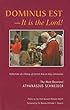
The book is in two parts. The first recounts the heroic life of those Catholic women who during the years of communist rule brought communion to the faithful in secret, defying the prohibitions. And the second explains the faith that was at the origin of that heroism: a faith in the real presence of Jesus in the Eucharist that was so strong as to be willing to die for it.
And it is against this background that Bishop Schneider revisits the Fathers of the Church and the history of the liturgy in the West and in the East, shedding light on the origin and reinforcement of this adoring manner of receiving communion kneeling and on the tongue.
When pope Ratzinger read Bishop Schneider’s manuscript in 2008, he immediately ordered the Libreria Editrice Vaticana to publish it. And it did, in Italian and Spanish.
The English edition of the book has a preface written by the archbishop of Colombo, Ranjith.
 ROME, October 14, 2010 – In Sri Lanka, the bishops and priests dress all in white, as can be seen in the unusual photograph above: with the entire clergy of the diocese of Colombo, the capital, diligently listening to its archbishop, Malcolm Ranjith, who is likely to be made a cardinal at the next concistory.
It seems to me that a great deal could be accomplished toward “the new evanglization” were these liturgical strategies adopted widely.