Here is a counterpoint to the position many of the readers will have.
You should also check out his blog. You will find that he is a fellow traveler. This fellow is no liberal.
The Happy Priest: Why I Love to Celebrate the Mass of Vatican II
By Fr. James Farfaglia
10/12/2010CORPUS CHRISTI, TX (Catholic Online) – Since the close of the Second Vatican Council (1962-1965), the Catholic Mass of the Latin Rite has been the focal point of intense debate and, in some cases, conflict within the Roman Catholic Church
As a Catholic priest I have been very happy celebrating the reformed liturgy of the Second Vatican Council. Although I do not have any problem with anyone who has an affinity to the Tridentine Latin Mass (now also referred to as the “extraordinary form”), I personally do not share in that same affinity. Based upon long experience, I firmly believe, that properly understood and correctly implemented, the Mass of the Second Vatican Council is a better liturgy and that there was a real need for the Church to reform the Tridentine Latin Mass. [We shall see if he addresses the fact that what the Council mandated for a reform is not actually the reform we got.]
Unfortunately, many Catholics have been deprived of the beauty of what the Second Vatican Council actually intended. As a priest, I have made it my mission in life to do what I can to promote a correct understanding and implementation of the liturgical reform of the Second Vatican Council. I personally disagree with those who claim that we need a reform of the reform. I believe that we simply need to implement the reform correctly.
Unfortunately, shortly after the close of Vatican II, the liturgical reforms that the Council set in motion were upset by ignorance, misinterpretation and even infidelity.
I really love celebrating the reformed liturgy of the Second Vatican Council, now called the ordinary form. I understand what was changed and why. I find these changes to be very beautiful, [There’s that “beautiful” again. I hope there will be examples of what he means.] meaningful and exciting. The Liturgy, especially the Sunday Liturgy, fills me with intense joy and draws me into the mystery of God.
Why do I prefer the ordinary form of the Catholic Mass?
The use of the vernacular in the liturgy came from the Vatican II document on the liturgy, Sacrosanctum Concilium. However, it must be understood that the principles elaborated in this Vatican II document were already being widely developed in what was called the Liturgical Movement which began during the Pontificate of St. Pope Pius X and which became a very intense movement from the Pontificate of Pius XII right up to the opening of the Second Vatican Council (1962 – 1965). There were even isolated places where the Holy See allowed the use of the vernacular in the Latin Rite before Vatican II. We should also remember that the Eastern Catholic Church has always used the vernacular in their liturgy. So, let us keep in mind that the vernacular is not a new idea. [Is this an example of what is “beautiful”? The lame-duck ICEL translation? And if the Eastern Churches used “vernacular”, they were not using just common sounding language.]
Personally, I think that the widespread use of the vernacular is good reform from the Second Vatican Council. [Even if we grant that the use of vernacular can be at times of advantage, the Council actually said that Latin was to be retained and that the vernacular could be used at times and in limited ways. So, if we are dedicated to implementing what the Council actually said, we should be using a great deal more Latin, no?] This is particularly true with the Liturgy of the Word. However, it was not the mind of the Council, nor is it the intention of the Church today, that the Latin language should be considered something of the past, never to be used again in the Catholic Church. The liturgical life of a parish must be in the vernacular, [“must” be? Really? Why?] but it is also very important that Latin, both in the prayers of the Mass and the liturgical music, should be present frequently throughout the liturgical year.
Nationally, there is an interesting phenomena occurring: while some older priests and laity are repelled by any use of Latin, conversely more and more young priests and laity are finding the use of Latin to be exciting, fulfilling and very spiritual. Parish choirs directed and filled with young people are singing Gregorian Chant and polyphony. [And yet parish liturgies “must” be in the vernacular.]
One of the most noticeable reforms of the Missal of Pius V has taken place with the Liturgy of the Word. In my opinion, this was one of the best reforms because it allows the Word of God to be proclaimed in the language of the people and it provides a greater variety of biblical texts for the enrichment of our spiritual life. [We could grant this point, though perhaps the three readings on Sunday was not such a good idea.]
The Liturgy of the Word on Sundays and Solemnities is comprised of three selections from the Bible. Outside of the Christmas and Easter Seasons, the First Reading is always taken from the Old Testament. During the entire liturgical year, the Second Reading is always taken from the New Testament. The Gospel passage is taken from any of the four Gospels: Matthew, Mark, Luke and John. The Liturgy of the Word follows a three year ABC cycle which provides a rich variety of readings from the Sacred Scriptures.
Between the First Reading and the Second Reading, one of the 150 Psalms is sung or said. The Responsorial Psalm provides a prayerful meditation between the two passages from the Bible. [Frankly, I think this is one of the least successful changes in the post-Conciliar reform.] Between the Second Reading and the Gospel, the Alleluia verse is sung or said. [It was ever so.]
The other reform that I really enjoy is the variety of Eucharistic Prayers during the Liturgy of the Eucharist. [I cannot agree.]For many centuries, the Mass had only one Eucharistic Prayer, which we now call Eucharistic Prayer I. Immediately after the Second Vatican Council, the Church added three more Eucharistic Prayers to the collection. Eucharistic Prayer V, Eucharistic Prayers I and II for Reconciliation, and Eucharistic Prayers of Children have followed since.
Eucharistic Prayer II is an adaptation of the Eucharistic Prayer found in the third century. Scholars believe that Saint Hipolitus composed this prayer. [Ummm… no, they don’t. That was all pretty much wrong.] Eucharistic Prayer III is a new composition that while similar in some respects to the First Eucharistic Prayer, does incorporate some elements from other sources. Eucharistic Prayer IV is related to an ancient prayer used in Egypt and later adapted into what came to be known as the Anaphora of St. Basil. [And no one uses it.]
Finally, Sacrosanctum Concilium gave us the words active participation. [No, these words and the concept behind them were around for quite some time before the Council. the Council adopted them and made them a centerpiece of the Constitution on Liturgy.] At the time of the Council of Trent, the Catholic Church was going through a very difficult time. The sacrificial nature of the Mass, the ministerial priesthood and transubstantiation were all under intense attack from the Protestant reformers. Therefore, the Church decided that the liturgy should emphasize these essential aspects of our faith. [Problem: All those things are under intense attack now. And not just from Protestants, but from within the Church herself.]
The concept of active participation within the Catholic Mass, as understood by Sacrosanctum Concilium and the Liturgical Movement leading up to the Second Vatican Council, restores the proper participation of the laity due to their membership within the priesthood of the faithful. [I am not so sure that we are talking about a “restoration” of active participation, particularly in view of the fact that “active participation” has been so very misunderstood.] Thus, the reformed liturgy of the Second Vatican Council brought about a beautiful [there it is again] relationship between the ministerial priesthood and the common priesthood of the faithful. [In what way did the older form of Mass not do that?]
On the First Sunday of Advent 2011, we will be using a new translation of the English Mass. I can’t wait! What a gift! [FULL AGREEMENT.] In preparation for this great moment in the life of the Catholic Church I will be offering a series of articles regarding the meaning and significance of this important development.
I agree with much of what this priest is saying. I have seen what can be accomplished by using the Novus Ordo properly, in continuity with our tradition, in fidelity to the books. However, the parishes where that was actually done, where the liturgy of the Second Vatican Council was actually implemented in that spirit were as rare as hen’s teeth.
While the writer seems to be trying to avoid openly negative references to the older form of Mass, his overarching effect was to … how to say this… run it down as inferior?
He is surely entitled to his preferences. He gives some reasons for what he thinks, though they are not always crystal clear to me how they fit with the actual mandates in Sacrosanctum Concilium.
At the end I am left with a few questions.
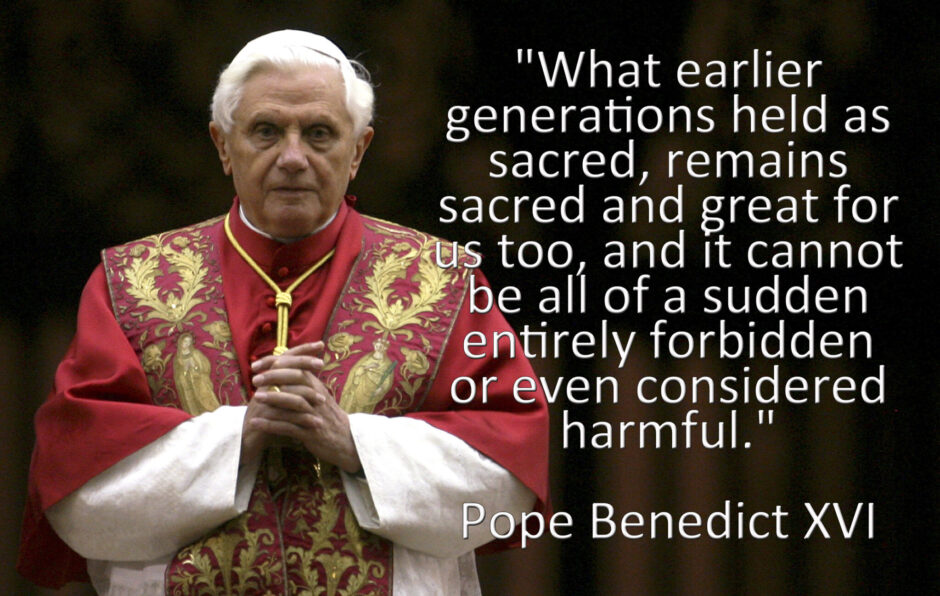
Pope Benedict determined that the older form of Mass was to be more widely available and experienced. He did this for a reason. Why? He sees that our worship has experienced discontinuity and rupture. Pope Benedict, before his election (and after) has been a proponent of a reform of the reform. Is the writer out of step with Pope Benedict’s thought? Perhaps we could frame this in terms of a “new liturgical movement”, rather than a “reform of the reform”. Either way, if we actually did what the Council asked, we would see in our parishes a Mass that resembled much more the older form. And if that is the case, if the older form remains the model for the Roman Rite (and I think that is in part what Pope Benedict was signaling), then we are pushed to ask another question: Why not just use the older form?
Realists can answer that, of course.
Another point.
The older form of Mass has a pretty good track record, all in all. Take a look at a list of saints and try to determine which Mass they attended. Was it the older or new? The great centuries of missionary work of the Church were accomplished with which liturgy? Older? Newer? You can go on from there. The point is that the older form has a pretty good track record. We don’t yet know what sort of track record the newer form has. I suppose we could look at the numbers of confessions heard these days, but … I don’t want to pile on. To be fair, the Novus Ordo has been a short blip so far. And we haven’t seen it implemented properly.
That said, I can understand quite well what the priest is driving at and I even share some of his views about the newer form of Mass.
I am all for a proper implementation of the Novus Ordo. Let’s actually give it a shot! After all, it really hasn’t been tried.