We’ve seen notices from a diocese of chancery decrees (bullying?) imposing that people remain standing after Communion, instead of having personal freedom to kneel in prayer and awe about the Presence within them. No, No! You MUST STAND.
My friend His Hermeneuticalness, Fr. Finigan, has a good post about this in which he points out several reasons why such dictatorial practices are just plain wrong. I’ll give you bullet points, but you should read the whole commentary with his explanations. Here are his several Things That Are Wrong™.
1st Wrong Thing. It interferes with a proper desire to adore God and to be recollected.
2nd Wrong Thing. There is no mandate for it.
3rd Wrong Thing. It is an unwarranted extension of the authority of the clergy.
Bonus Wrong Thing. It imposes a ridiculous uniformity.
I might add another point: It can’t be enforced.
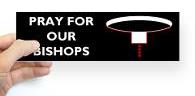
Fr. Finigan also picks up on something that I made a long time ago for a different reason. Fun.

There’s an interesting backstory to the creation of this item of Z-Swag.
UPDATE:
There was a dubium … a dubium answered … by the CDW under Card. Arinze. It is on record at EWTN.
POSTURE OF THE FAITHFUL FOLLOWING COMMUNION
Congregation for Divine Worship and the Discipline of the Sacraments
Francis Cardinal George, O.M.I., Chairman of the Bishops Committee on the Liturgy, received the following clarification concerning the right interpretation of the “General Instruction of the Roman Missal” on the posture of the faithful from their own reception of Communion until the period of sacred silence after all Communions have been received (at which time they may sit or kneel as they prefer). What is noteworthy is the clarification of the mind (mens) of the Holy See on the uniformity of posture of the faithful.
5 June 2003Prot. n. 855/03/L
Dubium: In many places, the faithful are accustomed to kneeling or sitting in personal prayer upon returning to their places after individually received Holy Communion during Mass. Is it the intention of the Missale Romanum, editio typica tertia, to forbid this practice?
Responsum: Negative, et ad mentem. The mens is that that the prescription of the Institutio Generalis Missalis Romani, no. 43, is intended, on one hand, to ensure within broad limits a certain uniformity of posture within the congregation for the various parts of the celebration of the Holy Mass, and on the other, to not regulate posture rigidly in such a way that those who wish to kneel or sit would no longer be free.
Francis Cardinal Arinze
PrefectNB: This clarification was published in the July 2003 edition of the Newsletter of the Bishops Committee on the Liturgy. [So… it is available in every chancery in these USA.]
“General Instruction of the Roman Missal,” Missale Romanum, 3rd typical edition
43. The faithful should stand from the beginning of the Entrance chant, or while the priest approaches the altar, until the end of the Collect; for the Alleluia chant before the Gospel; while the Gospel itself is proclaimed; during the Profession of Faith and the Prayer of the Faithful; from the invitation, Orate, fratres (Pray, brethren), before the prayer over the offerings until the end of Mass, except at the places indicated below.
They should, however, sit while the readings before the Gospel and the responsorial Psalm are proclaimed and for the homily and while the Preparation of the Gifts at the Offertory is taking place; and, as circumstances allow, they may sit or kneel while the period of sacred silence after Communion is observed.
In the dioceses of the United States of America, they should kneel beginning after the singing or recitation of the Sanctus until after the Amen of the Eucharistic Prayer, except when prevented on occasion by reasons of health, lack of space, the large number of people present, or some other good reason. Those who do not kneel ought to make a profound bow when the priest genuflects after the consecration. The faithful kneel after the Agnus Dei unless the Diocesan Bishop determines otherwise.
With a view to a uniformity in gestures and postures during one and the same celebration, the faithful should follow the directions which the deacon, lay minister, or priest gives according to whatever is indicated in the Missal.