From a reader comes new from the Diocese of Fort Wayne-South Bend, where His Excellency the exemplary John M. D’Arcy is bishop.
His Excellency has made a statement about the placement of the tabernacle in churches of the diocese. Document.
Here is the cover letter with his statement with my emphases and comments:
PROMULGATION OF DIOCESAN NORMS
June 14, 2009 Feast of Corpus Christi
To Priests, Deacons, Religious, and to All the Faithful,
The presence of Jesus Christ in the Blessed Sacrament is at the center of our faith and of the devotional life of our Catholic people.
In recent years, the place of the tabernacle in our churches has become a source of controversy. This should not be. The Eucharist, whether we are referring to its celebration or to the place of reservation, should always be a means of unity and communion, and never of division.
The place of the tabernacle in our church should reflect our faith in the real presence of Christ, and should always be guided by Church documents.
My experience is that our people, with their instinct of faith, have always desired that the tabernacle be central and visible. They find it confusing when the tabernacle in their churches is not visible, and if possible, central. [Amen. Alleluia.]
Because of my responsibility to foster the devotional life of our people, and to keep it sound, I have asked our Office of Worship to prepare norms for the placement and design of the tabernacle in this diocese. These norms were brought before the Presbyteral Council, the Liturgical Commission, and the Environment and Arts Committee. Suitable refinements and improvements were prepared.
These norms are promulgated to the Diocese of Fort Wayne–South Bend on June 14, 2009, the Feast of Corpus Christi, the Body and Blood of the Lord. They will be effective on August 4, 2009, the Feast of Saint John Mary Vianney, the patron saint of priests, in whose honor the present Year for Priests has been dedicated by the Holy Father Benedict XVI.
I urge all priests to follow these norms carefully and completely, and most importantly – to foster devotion to the Blessed Sacrament.
With every best wish and prayer, I remain
Sincerely yours in our Lord,
Most Reverend John M. D’Arcy
Bishop of Fort Wayne – South Bend
"But Father! But Father!", surely you are by now eagerly shouting. "Don’t leave us in suspense! What does the bishop really say?"
Here are a couple highlights from the norms which you can read on your own.
4. In the Diocese of Fort Wayne-South Bend, the Bishop has judged that the tabernacle is normally to be prominently located in the sanctuary of the church, along the central axis behind the main altar. Under this arrangement, the tabernacle should be at an elevated, open location in the apse area, or in another central place in the sanctuary that is equally conspicuous. Where a high altar with a tabernacle remains in place, it is appropriate to continue using this noble structure for the reservation of the Blessed Sacrament.
5. This prescription is to be observed in all future construction or restoration projects involving places of sacred worship (including all churches, oratories, and private chapels) in the Diocese. Any exception to this norm must be approved by the Diocesan Bishop, and must clearly demonstrate itself as a worthy alternative that would accentuate the sacramental nature of the church building and contribute to the spiritual life of the worshiping community.
6. In those existing places of sacred worship where the tabernacle is currently located elsewhere in the sanctuary or the main body of the church, a liturgical consultation with the faithful and with the Diocese should begin, regarding the possibility of moving the tabernacle to a central position in the sanctuary. Especially if the tabernacle in a particular church was central at one time and then was moved, it should be returned to its original location.
…
24. Aside from tending to the tabernacle itself, we must ensure that the faithful receive proper guidance and formation with respect to reverence before the Blessed Sacrament. [Amen. Alleluia. I would add RECEPTION as well… but that is not the topic of these norms.] Today there are many of all ages who inadvertently do not genuflect or bow in the correct situations.
Care should be taken to instruct the faithful that genuflection is the appropriate sign of adoration in the presence of the Blessed Sacrament, “whether reserved in the tabernacle or exposed for public adoration.” Before or after Mass, when the tabernacle is visible somewhere in the church, genuflection should be directed towards it. Although those who genuflect when a tabernacle is not present or when the Blessed Sacrament is clearly removed from the tabernacle (for example, during much of the Sacred Triduum) typically do so out of a commendable pious habit, they should instead bow out of reverence towards the altar.
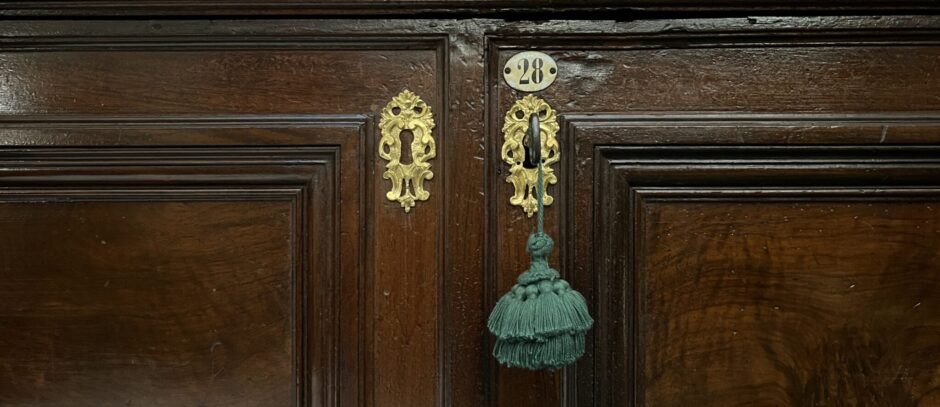
25. Every church should strive to make the tabernacle accessible for prayer during the day, and to preserve a peaceful setting favorable to prayerful visits. Meetings and other activities without a strictly spiritual purpose should therefore be held elsewhere on the church premises whenever possible. Under extraordinary circumstances, such as if it became necessary for a church to host an event of a purely secular nature, the Blessed Sacrament may be removed from the tabernacle and transferred to the sacristy or another suitable place. The location should be secure, with the ciboria veiled and the Lord’s presence clearly marked.
WDTPRS sends huge kudos to Bp. D’Arcy for another good day’s work in the Lord’s vineyard.