Someone was kind enough to send me an unofficial translation of the statement by the Bishop of Helsinki (Finland), Most Rev. Józef Wróbel SCJ, on the implementation of the Motu Proprio Summorum Pontificum.
Again, since Finnish is entirely beyond me, I cannot verify all the phrasing of this translation.
My emphases and comments.
A Decree for the fulfilling [this sounds like it should be implementation] of the Motu Proprio "Summorum Pontificum" of Benedict XVI
On July 7th this year the Holy Father, Benedict XVI, published the Motu Proprio "Summorum Pontificum." The Motu Proprio will take effect on September 14th. In the document the Pope expresses his concern for the rightful reverence for God in the Church’s liturgy. The Pope also wishes to answer the ardent requests—and to respond generously—to the desires of those who feel an attachment to the older form of the liturgy of the Mass. At the same time, he hopes that this liturgical initiative will further the agreement with the Society of Pius X. [That is not all.]
In our diocese there are some [That makes it sound like not very many.] faithful who long for the older liturgy. Along with this Motu Proprio the faithful will also have the opportunity to participate in the older form of the Roman rite in our diocese. The expectations of these faithful are answered according to the decrees of the Motu Proprio, liturgical rules and the practical possibilities of our diocese. [Again… far and wide, many bishops think they have to publish norms to regulate the SUPREME PONTIFF’s provision before anyone has experienced them.]
In this situation I would like to remind that there are currently two commonly-known communities which officially use the traditional, so-called "Tridentine Mass" according to the Missal of Pope Pius V. One of the these communities is the priestly society of St. Pius X (Fraternitas Sacerdotalis Sancti Pii X, abbreviated "FSSPX"), which in the media is colloquially named according to the name of its founder ("Lefebrevists"). The society was founded after the Second Vatican Council by the French archbishop Marcel Lefebvre, after he would not acknowledge the decisions of the Council and the liturgical renewal, considering them a modernist heresy. The headquarters of the society is located in Ecône, Switzerland. This society is not in full communion with the Holy Father. Despite the great efforts of pope John Paul II, [And less hard work by others.] the Society has, with the lead of archbishop Lefebvre, left the Catholic Church. It is thus a schismatic society. [I believe the Holy See has backed away from this language. The press has been full of these statements which show that the Holy See, rightly or wrongly, is less ready to use the word "schism". Thus, it is a surprise to me that this term is used here.]An organization that must be held clearly separate from the Society of St. Pius X is the Priestly Fraternity of Saint (apostle) Peter (Fraternitas Sacerdotalis Sancti Petri, abbreviated FSSP). It was founded by the former members of the Society of Saint Pius X, who wished to remain in full communion with the Holy Father. From Pope John Paul II they also received the permission to celebrate the liturgy according to the old rite.
The topic of Pope Benedict’s Motu Proprio is the use of the Roman liturgy in the form found in the Roman Missal of 1962. It was generally used before the renewal [If that is the term actually used in the Finnish original, then someone needs to go back to the drafting table.] of the liturgy of the Mass, which was carried out throughout the church after the Second Vatican Council, in year 1970.
The renewed Roman liturgy—and especially the rite of Holy Mass—was not any sort of an expression of modernism in the church. [But it was an expression of the Church’s move to accomodate or adapt to the "modern world", right?] According to the decisions of the Second Vatican Council, the new liturgy was implemented with the permission of Pope Paul VI, so that the faithful could completely and actively participate in the liturgy and personally feel the sacrifice of Jesus Christ. [O my! This is simply dreadful. The implication is that before the so-called post-Conciliar "renewal" people could neither participate actively or "personally feel the sacrifice of Jesus". Absurd. This strikes me as betraying a rather simplistic idea of what "active participation" is.] The reason for the use of the vernacular is that the faithful can, above all, fully understand the liturgy as well as be personally united in Jesus Christ. [O brother. It’s getting worse and worse. First, you CAN’T "fully understand" Holy Mass. It is a mystery. The language won’t help you there. Secondly, does that "personally united" phrase smack just a little of the evangelical’s zeal for a personal relationship with Jesus approach? I think it is great that people sense themselves to be "personally united". How else are they going to be united? But this is simply strange.] In this way, the faithful unite the burden of their lives with Him, who sacrifices himself. In this way, the faithful may partake in the Eucharist more fruitfully. [B as in B. S as in S. Take a look at the Martyrologium Romanum and start counting the entries of blesseds and saints who were formed on the newer "renewed" liturgy. What were all those saints before the Council being nourished on? Chopped liver?]
The usage of the former Mass does not imply an abrogation or return to the past. [I wonder about this translation. The word "abrogation" seems very out of place here.] Thus, the Mass according to the Missal of 1970 will remain in the life of the church [Maybe he did mean "abrogation" after all.] — as the Holy Father emphasizes—always the ordinary form of the Roman rite. The older liturgy, instead, is only the extraordinary form of the same rite.In order to have the Motu Proprio realized in the same way throughout the diocese, and so that no misunderstandings should be conceived in the parishes due to the private interpretations [hmmm… what if the private interpretation as the correct or at least legitimate interpretations?] of the document, I confirm [!] the following matters:
1. Just as the Holy Father does, I solemnly ask all faithful who long for the earlier form of the celebration of the Mass, that they give primacy of place to the unity of the parish and the diocese as well as the necessary testament of faith before the parish. [What is this? This must be a Finnish thing. Otherwise, it might simply be another way of expressing Rule #4. In the mean time: how to you turn expressions of unity and faith into a NORM beyond the requirment that we say the Creed at certain Masses or make an adhaesio fidei at certain moments?]
2. I ask all faithful to respect each other. [Okay everyone! By solemn episcopal decree all disagreements are now officially over.] Different liturgical preferences may not in any case cause a lack of tolerance and respect in our personal relationships. Such attitudes are not fitting for a Christian’s love of neighbour.3. Because the renewed Roman liturgy will remain the main form of the liturgy, all public high masses in our diocese will continue to be celebrated only according to the Roman Missal of 1970. [Unless of course a pastor decides otherwise. Your Excellency… read the Motu Proprio again!]
4. In all parish churches, as well as in public and semi-public (also non-Catholic) chapels in which Masses are normally offered for the faithful (also when it does not take place every Sunday), the older form of Mass may not be used at the times at which until now the renewed Roman Mass has been celebrated. In other words, the renewed Roman Mass may not be replaced by an older liturgy. This applies to Sunday as well as feast days and Holy Days. [Unbelievable. This is terribly restrictive and, it must be said, intolerant things I have read from any bishop. He is definitely relegating anyone who wants the older Mass to the state of second class citizen. This attitude is wothy of a Selma-style protest.]
5. When asking for the older form of Mass it should not be forgotten that the priests of our small diocese have little possibility to reply in the affirmative to the requests of every group. [Unless he wants, as a pastor, to sacrifice his time for the flock.] Thus, no priest should be pressured into offering the older form of Mass often and regularly. ["But, by God, he’ll be pressured by me not to offer it! I’ll make sure he doesn’t want to by commanding him not to replace a Mass, but to add a Mass to his schedule. See if Father likes that!]
6. Each priest working in our diocese is allowed, according to his own possibilities, to celebrate a Mass in the older form for those groups of faithful, who ask for it. [But never publicly or on a schedule??] He must take into consideration the Pope’s Motu Proprio, [but I don’t have to] likewise all liturgical rules and this decree.
7. Each priest is allowed to privately say the older form of Mass when he so wishes. He must take note of all the currently valid liturgical orders.
8. a. In the private chapels of religious orders the older form of Mass may only be used with permission from the superior.b. Priests may also privately use the older form of Mass in the private chapels of religious orders only with the permission of the superior.
c. When laymen participate in the liturgy in the public and semi-public chapels of religious orders ( e.g. the guest house and great chapel of Stella Maris, the chapel of the Carmelite Sisters in Espoo, the chapel of the Missionaries of Charity in Helsinki and in Studium Catholicum) the same rules which concern parish churches and public chapels must be observed.
9. a. A group of the faithful may always invite a priest from abroad, who offers Mass in the older form. According to canonical orders, this priest must belong to the Roman Catholic church [What if he is from, say, Milan?] and be without canonical hindrances. Were such a priest come into our diocese regularly, he would need a permission given by the bishop (as any other priest, who regularly fulfils a pastoral function in our diocese).
b. Priests belonging to the Society of Pius X may not celebrate Mass for our faithful, as they are not in full communion with the Holy Father. [That’s open and tolerant.]
10. In contacts with the Society of Pius X one must follow the regulations having to do with intercommunion. [I suspect this is an issue in Finland.] One may attend the Mass offered by a priest of the Society of Pius X only as an exception. Even then one may not partake in Holy Communion, because this society is not in full communion with the Catholic church. [So, Canon Law doesn’t apply to the SSPX, though under certain conditions one could feasibly receive the sacraments from the Orthodox?]
11. a. Religious education must explain to the children what the older form of the Mass is and why it is said in a different manner. [Excellent!] The renewed Roman liturgy, which is mainly said in Finnish, will remain central in the public catechesis and public religious education (e.g., summer camps). [But those who desire the older form of Mass must drink only from the water fountains designated for them and sit in the back section of the bus.]
b. Because the Eucharist is always the celebration of unity and the community of the church [and, oh yah… the Sacrifice of the Cross and the Last Supper…], first communion may be offered only according to the newer form of the Roman rite [Unbelievable. I think people there would have a very good case in Rome if they wanted to protest this.]
c. One must not forget that many children and youth do not at all know what the older form of the Mass is. [except for those who attend it] Yet parents have the right, according to their own judgement, to familiarize their children with the older form of the rite. They should not forget, however, that children may thus easily become estranged from the community of the church. When they become adults, they may feel themselves completely foreign in the church and consequently, leave the church. Therefore I would like to ask all parents to regularly attend—as done at present—the High Mass of the parish. [Is this a NORM?]
12. Without the Bishop’s permission, the altars of the chapels and churches may not be moved or altered. This also applies to the altars in the public and semi-public chapels of religious orders in which laypeople usually participate at Mass. [Incredible.]
Helsinki August 6, 2007+ Józef Wróbel SCJ
Bishop of Helsinki
The poor people.
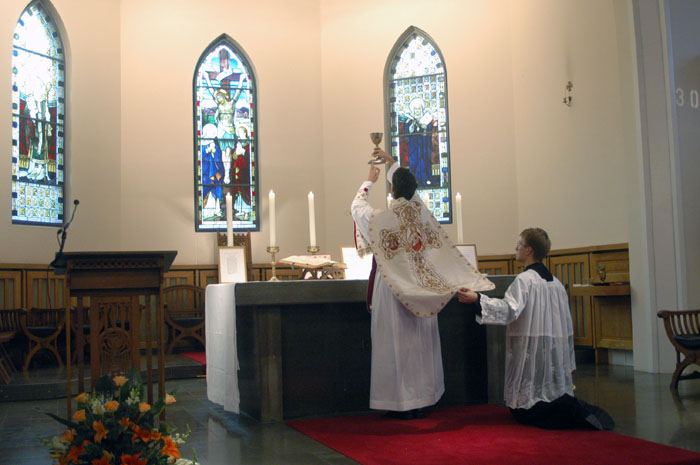
At the same time… and this really puzzles me… I receive a link to this story about the first public Mass with the older use in the Cathedral of Helsinki. I cannot read the Finnish, but I gather from the photos that it went well. The celebrant is Fr. Daniel Eichhorn, FSSP from Cologne. Perhaps some Finnish readers will jump in.