 I got this by e-mail:
QUAERITUR:
Why does the Church give us – in her Traditional Liturgy
– the Collect "Interveniat" for St Luke, seeing as it contains the
phrase "qui crucis mortificationem jugiter in suo corpore…
portavit"?
I was wondering about this while saying the Breviary and
serving Mass today.
While doubtless all should do so (cf. esp. 2 Cor 4:10;
also Lk 9:23; Gal 5:24), I would have thought this collect better used for St
Paul, who carried the marks of the Lord in his body (Gal 6:17), while I find no
special reference to stigmata, etc., regarding St Luke. Any ideas?
Here is the Collect:
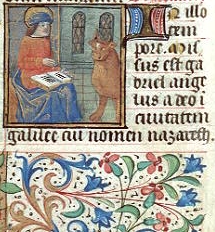 Interveniat pro nobis,
quaesumus Domine,
sanctus tuus Lucas Evangelista:
qui crucis mortificationem iugiter in suo corpore
pro tui nominis honore portavit.
There might be a couple reasons for this. First, Evangelists are associated closely with the Apostles, and so it might not surprise us that something from the Apostle Paul might be applied to others in that category.
This is strengthened by Luke’s strong association with Paul. We associate Luke and the Acts of the Apostles. Here also is the entry in the Roman Martyrology talking about how St. Luke was a companion of St. Paul:
Festum sancti Lucae, Evangelistae, qui, ut fertur, Antiochiae ex ethnica familia natus et arte medicus, ad Christi fidem conversus et comes carissimus beati Pauli Apostoli factus, in libro Evangelii, quae fecit Iesus et docuit, mansuetudinis Christi scriba omnia diligenter ordinavit et item in Actibus Apostolorum primordia vitae Ecclesiae usque ad primam Pauli in Urbe commorationem enarravit.
The so-called Golden Legend says of this matter:
[Luke] had rightful work and deed, and his work was rightful by intention,
and that is signified in his collect where it is said: Qui crucis
mortificationem jugiter in corpore suo pro tui nominis amore portavit:
he bare in his body mortification of his flesh for the love of thy
name.
The idea here is that when one applies oneself to one’s vocation properly, in all you do, you deny the urges of the flesh and therefore mortify your senses and appetites, which is a way of uniting oneself with the Passion of the Lord. It may be that this was thought to be apt because, as a physician, Luke would have seen much suffering, which is difficult to endure in one with great charity.
Other than that, it is a rather nice and pious thing to pray.
PS: For the Latin cited, above, maybe you readers would like to try your hand and offer the rest of us a smooth and accurate rendering.