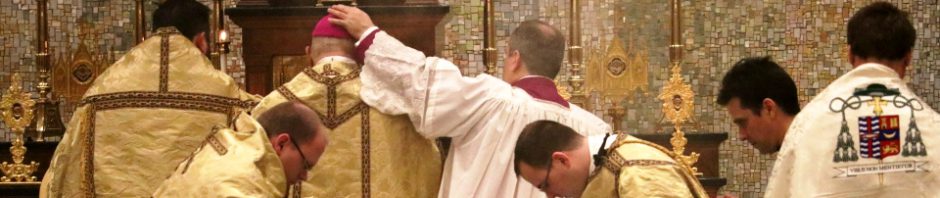
Damien Thompson of Telegraph.co.uk has a very interesting piece about how the older form of Mass is getting traction in the Diocese of Clifton, in England. A good point is made: "By allowing the Pope’s wishes to be implemented naturally, without interfering, he is showing that he is liberal in the best sense of the word."
I never thought I’d say this, but three cheers for Bishop Declan Lang of Clifton, two of whose parishes have begun celebrating the ancient Latin Mass five times a week, including on Sundays.
The Latin Mass has returned to Clifton
St Augustine’s Downend in Bristol and St George’s Warminster now offer the Extraordinary Form of Mass (formerly the Tridentine Mass) as a direct response to Pope Benedict’s Motu Proprio this summer. The bishop sees no problem with this – and good for him. Will other bishops follow his lead?
Fr Alexander Redman, the parish priest of St Augustine’s, told me the news via Facebook yesterday. And here is the evidence on his parish website. The 1962 Missal is used for the early Mass on Sundays.
It’s interesting that the Bishop of Clifton has a reputation as one of the Church’s more liberal (not to say Left-wing) bishops. By allowing the Pope’s wishes to be implemented naturally, without interfering, he is showing that he is liberal in the best sense of the word.
Now we need to know whether other dioceses are following the Clifton example. As I reported the other day, the Bishop of Leeds, Arthur Roche, has written an ill-advised letter implying that he wants to restrict the use of the traditional Missal – something he does not actually have the power to do.
The point is this: if two parishes in a diocese as small as Clifton have spontaneously adopted the Extraordinary Form, then there must be many more parishes in dioceses the size of Birmingham or Southwark that would like to do the same.
Please keep me informed, either by posting here or sending an email to editorial@catholicherald.co.uk. We need to find out exactly what is happening on the ground.