 I mentioned in another post that St. Jerome didn’t like St. Ambrose. He really didn’t like him. This needs an explanation. Why? Do you ever get the sense these days that many think the chief role of a priest is to be a nice guy?
Let us consider St. Jerome. He has a mixed reputation for a saint. Right?
First, keep in mind that Jerome (+420) was not canonized in the modern sense of the term, which involves a detailed examination of the life and works of a Servant of God so as to discern within a reasonable doubt that he lived a life of heroic virtue.
What’s with Jerome and Ambrose? Well, to get at this we have to bring in a third character, Tyrannius Rufinus of Aquileia.
 You are no doubt aware that Jerome and his old friend of his youth Rufinus (+410) had a titanic clash over the writings and teachings of the early Alexandrian exgete Origen. When they were young, they were very close, forming part of a group of dedicated Christians at Aquileia and then later at Jerusalem. They began to argue over the theology of Origen, but they patched things together before Rufinus left Palestine for Italy.
However, once in Italy Rufinus began to translate Origen Peri archon (De principiis). In his preface Rufinus made the mistake of assuming that just because Jerome had translated some of Origen’s work, therefore Jerome was a fan of Origen. People around Jerome also thought Rufinus purposely made Origen sound more orthodox than he was. These folks wrote to Jerome to let him know what they thought Rufinus was up to and asked Jerome to explain what was going on. In response Jerome translated Origen himself. In a letter he strongly denied being a partisan of Origen’s theology, even though he admired Origen’s skill. Jerome focused his laser on Origen’s statements about the resurrection and the preexistence of souls, and how the Persons of the Trinity related to each other which made him sound like a subordinationist. Jerome, in this second phase of translation, interpreted Origen in a very strict and harsh way.
 When you look at the way Jerome spoke of Origen the first time around, 12 years before, and what he did to him in the second round, it is pretty clear that this was a reaction to Rufinus’s written assumption about Jerome. Jerome was afraid that his own reputation was going to be damaged by a positive association with ideas which seemed very strange to many people, especially in the West. In short, he turned savagely on both Origen and Rufinus in order to defend his reputation. In defending himself Jerome was a little less than sincere.
Rufinus responded, of course. He had too. Rufinus pointed out, for example, that in a commentary on Ephesians Jerome had referred without objection to ideas of Origen about the preexistence and fall of souls into bodies. There are other points as well. Jerome responded with vitrolic force saying that some people (e.g., Rufinus), "love me so well that they cannot be heretics without me."
Of course the ways of saints are strange and fraught with problems. The postal service, or lack of one, actually plays an importance role in all of this. Jerome wrote a friendly letter to Rufinus assuring him of his high esteem and speaking of their past friendship and the passing of his mother. He expressed his desire to avoid a public fight.
The letter never reached Rufinus. Jerome’s friend Pammachius kept it, and pubished instead a letter of Jerome which accompanied his translation of Origen’s De principiis. Not having seen Jerome’s irenic gesture, Rufinus published his Apology, in response to Jerome the attacker.
 In Book II of his Apology, Rufinus points out how Jerome had attacked Ambrose. He mentions, as a matter of fact, Ambrose’ work De Spiritu Sancto which I wrote about yesterday. Thus, Rufinus about Jerome’s view of Ambrose. Rufinus relates more of Jerome’s distain for his "rival" in Milan (Apology 2,23-25) as he digs into accusations of plagiarism which were being hurled around. Rufinus says in 2, 23 that Jerome referred to Ambrose as a raven, a bird of ill omen, croaking and ridiculing in an strange way the color of all the others birds on account of his own total blackness… "praesertim cum a sinistro oscinem corvum audiam croccientem et mirum in modum de cunctarum avium ridere coloribus, cum totus ipse tenebrosus sit."
Again, going on about Jerome’s accusation against Ambrose of plagiarism, in 2,25 Rufinus continues about Jerome’s treatment of Ambrose with his own counter charges:
25. You observe how (Jerome) treats Ambrose. First, he calls him a crow and says that he is black all over; then he calls him a jackdaw who decks himself in other birds’ showy feathers; and then he rends him with his foul abuse, and declares that there is nothing manly in a man whom God has singled out to be the glory of the churches of Christ, who has spoken of the testimonies of the Lord even in the sight of persecuting kings and has not been alarmed. The saintly Ambrose wrote his book on the Holy Spirit not in words only but with his own blood; for he offered his life-blood to his persecutors, and shed it within himself, although God preserved his life for future labours.
Suppose that (Ambrose) did follow some of the Greek writers belonging to our Catholic body, and borrowed something from their writings, it should hardly have been the first thought in your mind, (still less the object of such zealous efforts as to make you set to work to translate the work of Didymus on the Holy Spirit,) to blaze abroad what you call his plagiarisms, which were very possibly the result of a literary necessity when he had to reply at once to some ravings of the heretics. Is this the fairness of a Christian?
Is it thus that we are to observe the injunction of the Apostle, “Do nothing through faction or through vain glory”? But I might turn the tables on you and ask, Thou that sayest that a man should not steal, dost thou steal?
I might quote a fact I have already mentioned, namely, that, a little before you wrote your commentary on Micah, you had been accused of plagiarizing from Origen. And you did not deny it, but said: “What they bring against me in violent abuse I accept as the highest praise; for I wish to imitate the man whom we and all who are wise admire.” Your plagiarisms redound to your highest praise; those of others make them crows and jackdaws in your estimation. If you act rightly in imitating Origen whom you call second only to the Apostles, why do you sharply attack another for following Didymus, whom nevertheless you point to by name as a Prophet and an apostolic man?
For myself I must not complain, since you abuse us all alike. First you do not spare Ambrose, great and highly esteemed as he was; then the man of whom you write that he was second only to the Apostles, and that all the wise admire him, and whom you have praised up to the skies a thousand times over, not as you say in two, but in innumerable places, this man who was before an Apostle, you now turn round and make a heretic.
Thirdly, this very Didymus whom you designate the Seer-Prophet, who has the eye of the bride in the Song of Songs, and whom you call according to the meaning of his name an Apostolic man, you now on the other hand criminate as a perverse teacher, and separate him off with what you call your censor’s rod, into the communion of heretics. I do not know whence you received this rod. I know that Christ once gave the keys to Peter: but what spirit it is who now dispenses these censors’ rods, it is for you to say. However, if you condemn all those I have mentioned with the same mouth with which you once praised them, I who in comparison of them am but like a flea, must not complain, I repeat, if now you tear me to pieces, though once you praised me, and in your Chronicle equalled me to Florentius and Bonosus for the nobleness, as you said, of my life.
 Is it thus that we are to observe the injunction of the Apostle, “Do nothing through faction or through vain glory”? But I might turn the tables on you and ask, Thou that sayest that a man should not steal, dost thou steal?
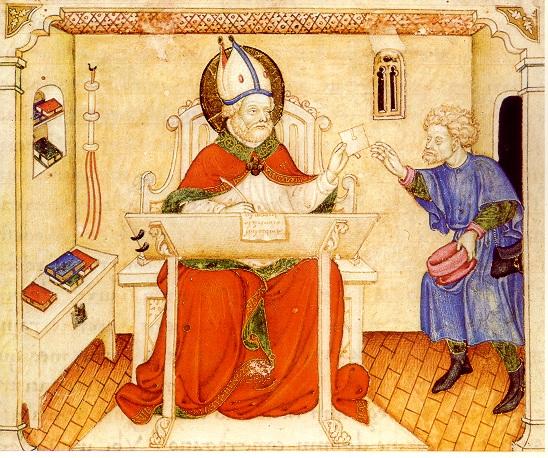
  And from Jerome’s own pen we have this vicious attack on Ambrose (ep. 69,9). Jerome was writing in the year of Ambrose’ death, 397, to a Roman named Oceanus who wanted Jerome to help him fight against a bishop in Spain who had married a second time. Jerome tells Oceanus to drop it, since that bishops’ first marriage had been before baptism. However, Jerome uses the occasion to take a somewhat less than oblique swipe at Ambrose. Ambrose had been popularly proclaimed bishop in Milan in 374 even though he had not even been baptized and had no theological training. The emperor, who wanted peace, acceded and within a week Ambrose was baptized and consecrated bishop. Jerome, who had probably been disappointed that he hadn’t been made bishop of Rome, surely felt the sting of this meteoric rise of Ambrose. In any event, listen to Jerome:
One who was yesterday a catechumen is today a bishop; one who was yesterday in the amphitheatre is today in the church; one who spent the evening in the circus stands in the morning at the altar: one who a little while ago was a patron of actors is now a dedicator of virgins. Was the apostle ignorant of our shifts and subterfuges? Did he know nothing of our foolish arguments? (Heri catechumenus, hodie pontifex; heri in amphitheatro, hodie in ecclesia; uespere in circo, mane in altari; dudum fautor strionum, nunc uirginum consecrator: num ignorabat apostolus tergiuersationes nostras et argumentorum ineptias nesciebat?)
Okaayyyy! That’s "NO!" vote from Jerome.
This is all very discouraging, in a sense, but important matters in the Church are sometimes hammered out through the instrumentality of weak men who are driven by love and zeal. Sometimes nice guys finish last, too. Still, all of us are bound to seek the truth and God will be the final Judge of our intentions.